Leon Tahcheechee, findings
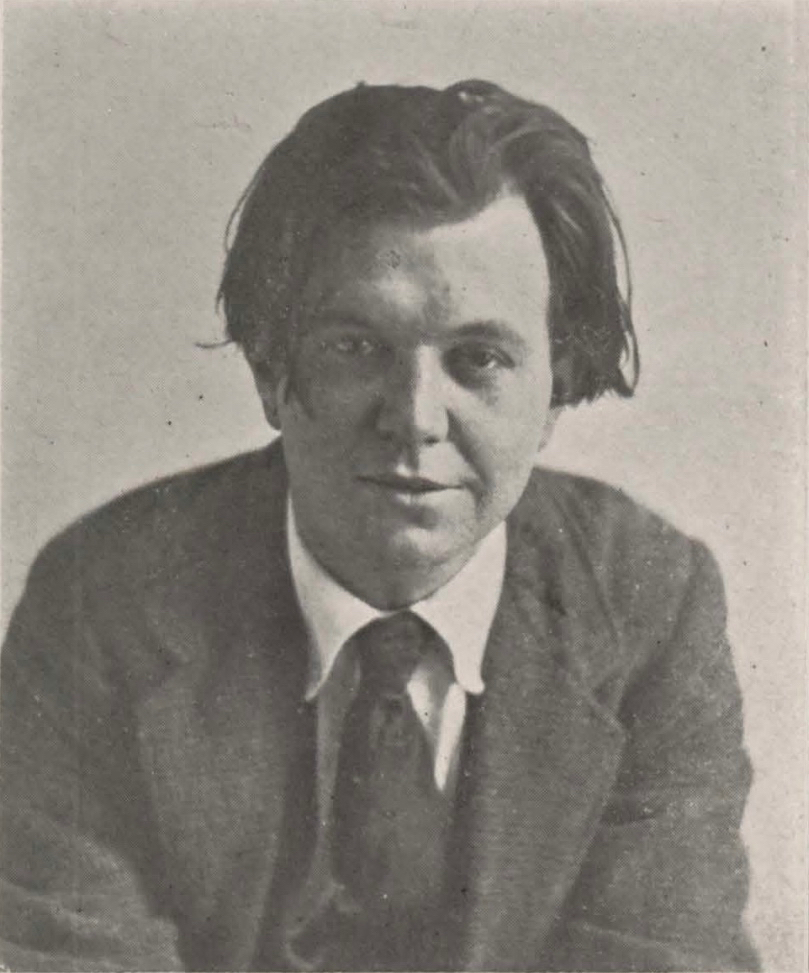
ex Paintings of Africa brochure (Babcock Galleries, 1921)
It was a letter, and a quote therein from Vernon Lee — “a something of a break, which marks it as mere sound” — that led to Leon Tahcheechee (Tahch) Corwin, writer, artist, traveler, self-styled aboriginal in 1920s Greenwich Village. This page brings together some of what I can find (which so far does not include years of birth and death).
writings
a something of a letter (that brought me here)
as artist
additional biographical (slim, very slim)

writings
- “Florentine Humoresque”
The Commonweal 7:7 (December 21, 1927) : 839-840
Northwestern U copy/scan (via hathitrust) : linktranscription : 2962_tahcheechee-florentine-humoresque
“Leon Tahcheechee is a native of Oklahoma, and a painter as well as an author.”
854 : link - “Pop Hart Himself”
review of George O. “Pop” Hart. Edited with an introduction. By Holger Cahill. New York: The Downtown Gallery
in Theatre Guild Magazine (April 1929) : 53-54
U California copy/scan (via hathitrust) : linktranscription :
Here are twenty-four carefully selected examples of ‘Pop’ Hart’s work with a sympathetic — though measured — statement by Mr. Cahill, garnished with a quotation from Gertrude Stein’s The Making of Americans in which she asserts “vital singularity is as yet an unknown product with us . . . it is sad for us, there is no place in an adolescent world for anything eccentric like us . . . ” I feel, however, that ‘Pop’ Hart confutes this bald statement; for Mr. Cahill’s forword seems to prove conclusively that there is a place here — and elsewhere — “for us singulars.” But, what is a more important point in the present instance, ‘Pop’ is native in an adolescent world; he would be ot of gear in a more traditional one.
Mr. Cahill in interpreting Hart: “He says in his pictures that we're a pretty rough lot if you want to think so, but at bottom we're a pretty swell lot.” I believe the second proposition is more true in this case. For ‘Pop’ is a great traveller. The whole world has seen him, even if it has not yet come to know much of him. He has gamboled over the earth’s surface without a Cook’s guide (except once), without letters of credit, without American Express checks, without even a Baedeker. And &mdash to rever once more to the question of “singulars” — ‘Pop’ Hart is still a very young man and one whom life has used with careful care although in actual years he is in the sixties.
The foreword of this little brochure is in a way a self portrait of the artist. Mr. Cahill has caught marvellously well the turn of ‘Pop’ Hart’s speech and allowed him to render his story and his credos through his own mouth. It gives one the idea of a capricious youth balancing his life as an egg on the point of a billiard cue. . . . ‘Pop’ is a man who is [54] very sure of what he has seen but not at all sure of what he thinks. His credos are given — after the manner of people who talk much — in a series of half evasions rather than in direct statement.
As artist in his medium, has has the capriciousness of a child. His style is as changeable as his abode has been. Mr. Cahill says there is no doubt that Hart has been influenced by Daumier. But I believe there is no style to be found among the examples selected for this book that are ‘Pop’ Hart’s directly. They remind one now of Goya (Dias de Fiesta, No. 1, Mexico, 1926, and Carnival Scene, West Indies, 1921) now of Hokusai (Matching and Weighing the Birds, Mexico, 1927), now of Karl Marc (Riding Ponies, Palisades Amusement Park, 1926), of Daumier in several pieces and others as well. But the comparison with Daumier is the best because the likeness is most obvious and constant. And it is here that his innocence, his lack of acid, is seen to best advantage. He sees people with the uncanny directness of a child, as the child in the fairy tale who saw the naked king; he sees in people their utter queerness. The world of humans is still strange and glamorous to him. All his people — including his portrait of himself — resemble the characters in Alice in Wonderland. Such pieces as the Mule Car, Mexico, 1926, have the fabulous unreality of a child’s impression about them. Mr. Roger Fry has remarked wisely of Daumier that the sentiment of his work was much nearer the tragic than the comic. The sentiment of ‘Pop’ Hart’s work is much nearer the monstrous than the humorous. And I believe it is because of this fantastical squint that the bulk of his work achieves a spiritual homogeneity. Those pieces where the species does not appear are the workds of a different and not very unusual man.
Leon Tahcheechee—
George Overbury “Pop” Hart (1868-1933), painter, illustrator, traveler (supported travels by sign painting)
wikipedia : linkThe Getty Research Institute copy/scan of George O. “Pop” Hart : twenty-four selections from his work (1928), reviewed above, is available via archive.org : link
aside —
wonder if both “Florentine Humoresque” and “Pop” Hart might have been precursors to Tahcheechee’s novel Valencia, which I know, so far, only via its reviews.
- Valencia
(Coward-McCann, New York, 1931)
LoC : permalink—
contemporary reviews of Valencia
- under the head “‘The Square Circle’ and Some Other Works of Fiction” in The New York Times Book Review (Sunday, May 10, 1931) : 8-9 : link (paywall)
Exotic Adventure
VALENCIA. By Leon Tahcheechee. 344 pp. New York: Coward-McCann. $2.50.
Those who prefer an exotic adventure story to a psychological novel will find excellent fare in this romantic but urbane and often witty tale laid in Spain. It should please masculine tastes and afford relief both from the usual run of absurdly plotted and poorly written adventure fodder, on the one hand, and from the flood of feminine emotionalized psychology on the other. The plot makes a good story without dominating the material; the color and glamour of Barcelona and Valencia and the Spanish people and countryside are revealed with warmth but faithfully; and the characters emerge and come to life in spite of their bizarre natures and the subtle, indirect approach of the author to them. Mr. Tahcheechee, moreover, has constructed his tale with considerable art, and he writes with charm.
Cross Willard is an American artist and wanderer who has knocked about Mediterranean Europe for several years, earning his way by painting when possible, turning to more devious pursuits when necessary, sending for money from home when worst comes to worst. It is in Valencia that he takes up the practice of occult sciences. He learns to read fortunes from the cards according to ancient gypsy lore and is soon making a fair income at it. And through his fortune telling he becomes friendly with the simple, dreamy, odd, delightful Count of Jenor and his villainous cousin, the Marquis. He is involved with Marija, the passionate gypsy girl, Pepita, who wishes to be thought the modern Spanish woman who has won complete freedom, and the intangible Doña Lola. And he acts as a second in a farcical duel and as a witness at a trial for parricide. There is also, of course, the inevitable bull fight. “Valencia” is a refreshing change from the general order of light fiction-indeed, from sentimental tales like “Flamenco” and “Rogue Herries” which have been hailed as important. It is both sophisticated and dramatic, and it is amusing. The dark thread carried along by the many readings of the cards, while not to be taken too seriously, does, perhaps, tend to mar the story by introducing too strong an element of the supernatural. But often the novel is touched up with an occasional bit of that sardonic humor, that delightful waywardness, to be found in “South Wind.” - “Valencia, Novel of Life in Spain.”
review in the Springfield [Massachusetts] Weekly Republican (June 25, 1931) : 8
via LoC’s Chronicling America : linkA peculiarly intimate quality characterizes the presentation of Leon Tahcheechee’s “Valencia” (Coward-McCann, New York; $2.50). As the narrative advances, one finds himself getting to know its people and events as he does the people and their doings with whom he comes frequently into contact in his everyday experience. It’s the kind of intimate acquaintance that one feels toward people when he has lived in the small community with them a long time.
The story is and is not Spanish. Insofar as the actual Valencia is Spanish, “Valencia” the fiction is Spanish, from its irresponsible and intense gypsies up to its simple-hearted (and simple-minded) count, who barely escapes conviction for matricide. Rather melodramatic at bottom — in motive and conception — this crime, resulting from an admixture of religious Insanity, general and family superstition, avarice, and desire for personal revenge upon the count. In itself, however, the book is not melodramatic in method.
If “Valencia” represents social democracy as it is in Spain, we Yankees don’t know anything yet about the free mingling among different classes in the everyday course of life. Incidentally, one of the most active persons in the story is an American.
The novel is substantially depictive of individual, character, and social types, and off the beaten track for American readers. - among “the New Books / Fiction”
The Saturday Review of Literature 7:50 (July 4, 1931) : 948
via archive.org : linkA strange city quite incomprehensible to the American, and completely apart from his romantic conceptions. It is true, all the elements that we look for in the typical Spanish story are here : the decaying house of Jenor with its mad countess and its strange frail count — El Greco figures, fantastic and provocative; the lying, passionate gypsies living by the river, singing through the night — figures of a thousand tales; senoritas, a bull fight, a duel. Yet the whole tale is suffused with a foreignness, an apartness, that is hard to define. The people are doubtless actual, the descriptions detailed and authentic. One recognizes mandates of the directorate and the arrival of a foreign prince. Indeed for the curious investigator, “Valencia” would undoubtedly make excellent material. But there is something about the angle of vision that smacks of “Alice in Wonderland.”
An American tells the story, an American voluntarily divorced from his own country, a wanderer, enamoured of Spain, and a definite part of the Valencia he has chosen to live in. As a foreigner he should get perspective, but if he has, he fails to retail it to his readers. Like his American prototype in the story, he is a fortune-teller. And the anomaly of an American reading Spaniards’ fortunes in their own Valencia is quite in line with other grotesqueries in the book. It all reads a little mad. It is chaotic as to purpose, unoriented, its characters for a long time confused. Yet it is peculariarly fascinating — like a topsy-turvy city, rising up and surrounding one.
a something of a letter
- Your illustrious self no doubt has seen how Larches tremble in the wind? Your voice, illustrious Sultana, is one that falters, that has a catch in it that sends a sensation like a delicate electric shock up the spine, “a trifle hoarseness, a something of a break, which marks it as mere sound,” but gives it more power than that of sound. That voice therefore should be used to its fullest only for those who can whisper...
ex typewritten letter [1930?] to “Illustrious Sultana”
via archive.org, : Archives of the Downtown Gallery, by Edith Gregor Halpert
initial landing at archive.org : link
and directly via :
Smithsonian Archives of American Art
Downtown Gallery records, 1824-1974, bulk 1926-1969
Reel 5490 Frame 1035-1244: Correspondence, 1930 link
collection information, links to finding aids, &c. : linkThe phrase is from “Botticelli at the Villa Lemmi,” in Juvenilia : being a second series of Essays on Sundry Aesthetical Questions by Vernon Lee. Vol. 1. (London, 1887) : 77-129 (88)
see asfaltics 2724 : 2724—
note, appended to above letter —
Leon Tahcheechee / poet and adopted son of king. Who had a school for retarded children in Dingman’s Ferry Penn. He married Catherine Brett a psychologist who later married Niles Spencer the artist.Edith Gregor Halpert (1900-1970), owner of Downtown Gallery (initially with husband (and painter) Samuel Halpert; important dealer in avant-garde American artists
wikipedia : link
as artist
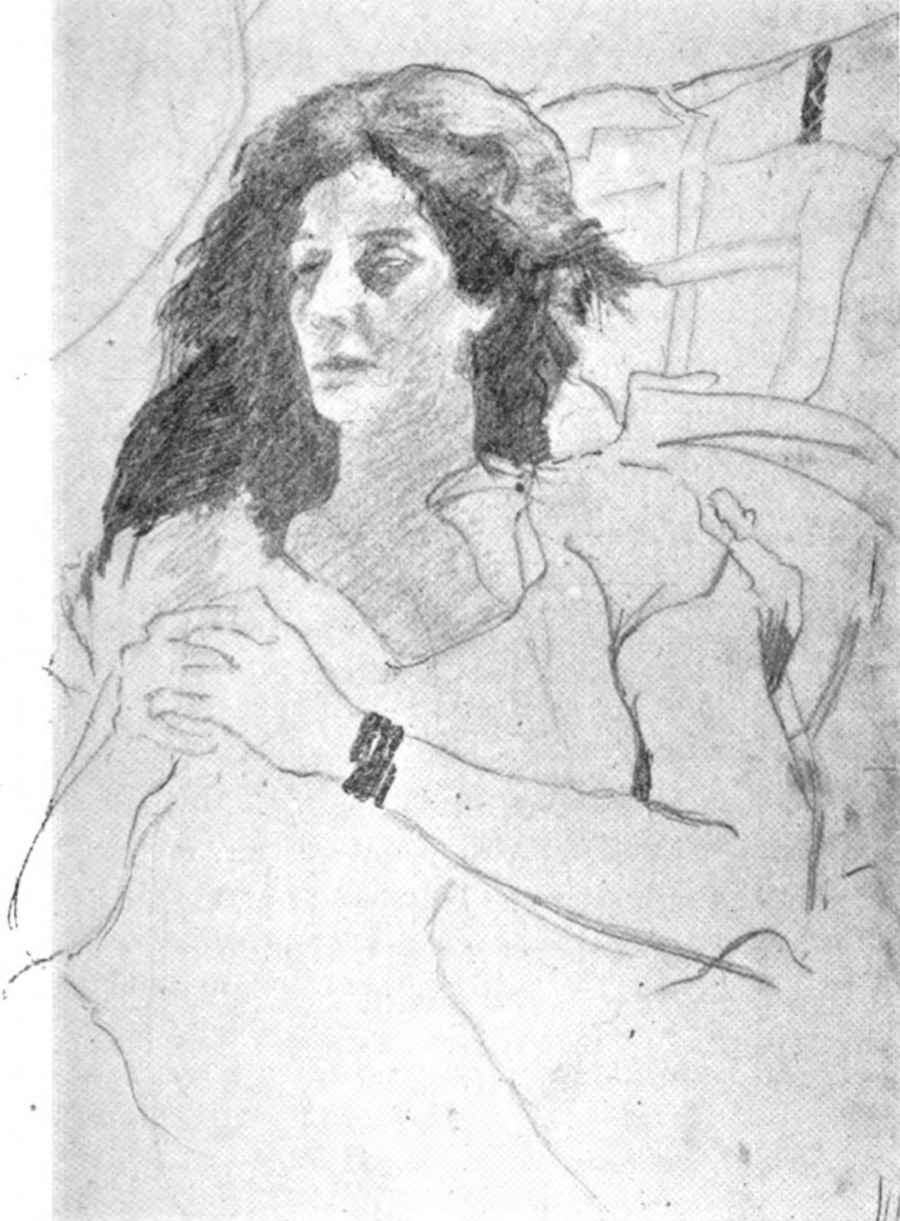
“a study” (pencil drawing)
in The Quill (“A Magazine of Greenwich Village”) 1:1 (June 30, 1917) : 9
via hathitrust : link
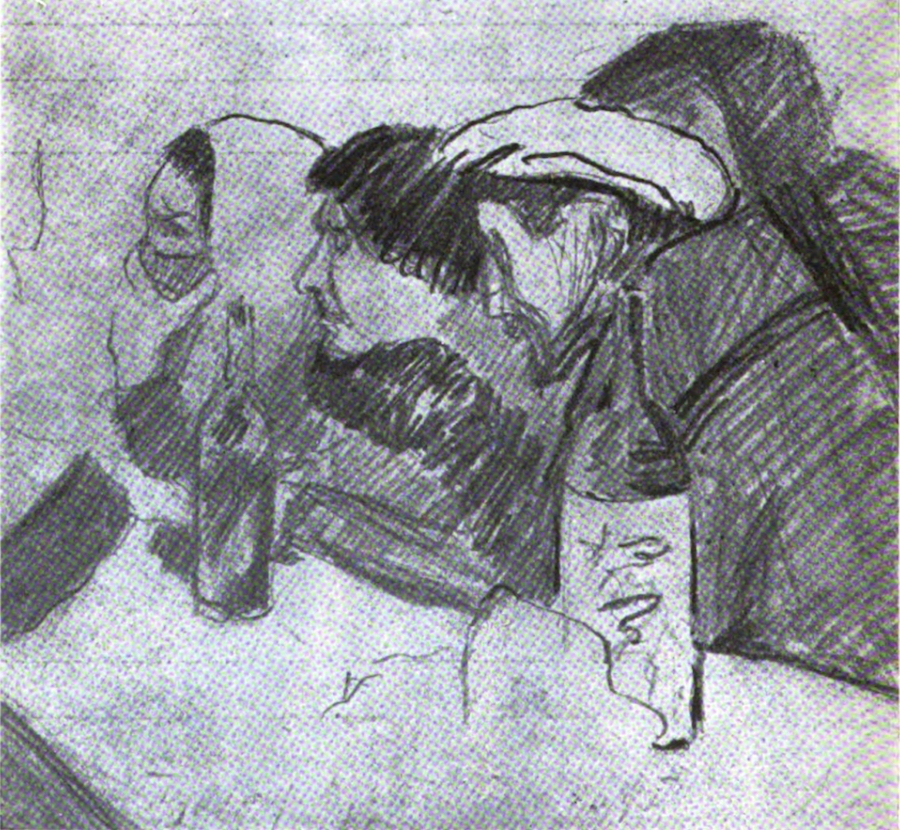
“Genoa — 1916 — A Café” (drawing)
in The Quill (“For, of and by Greenwich Village”) 1:3 (August 1, 1917) : 18
via hathitrust : link
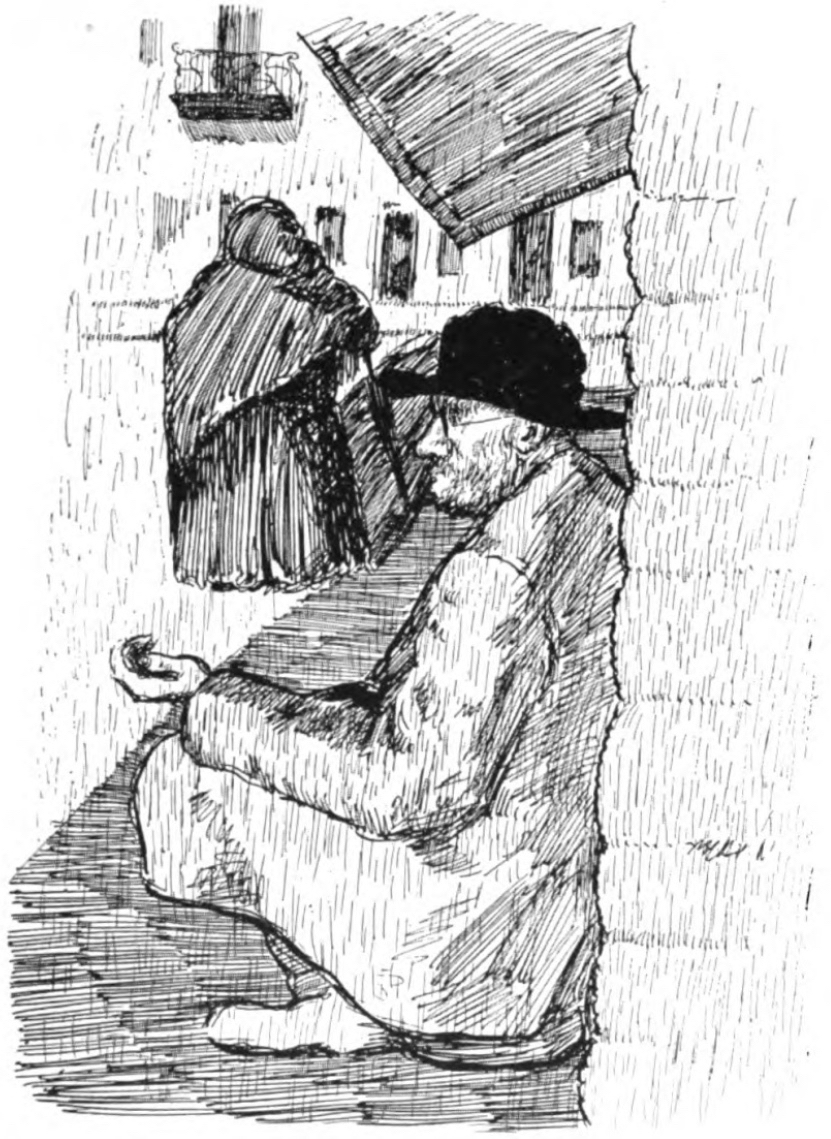
“Alms” (drawing)
in The Quill (“For, of and by Greenwich Village”) 2:7 (June 1918) : 5
via hathitrust : link
- Exhibition / Paintings of Africa by Leon Tahcheechee
Oct. 22 to Nov. 11, 1921
Babcock Galleries, 19 East 49th Street, New York
brochure, Frick Art Reference Library (via archive.org) : linkintroduction by Sadakichi Hartman [sic] :
Internationalism in art has come to say [sic]. By this I do not mean any special tendency, movement or school, for it really does not matter whether a work of art is international, local or individual, provided it has merit.
Leon Tahcheechee was born in Oklahoma Territory of Mexican and Hungarian parentage. A fiery racial mixture this, that should produce something unusual and powerful.
Tahcheechee won a scholarship in St. Louis when he was very young, and after these rudimentary exercises he was wise enough to attach himself to no school. His two aesthetic influences, he claims, were furnished by the personality of Balfour Ker and William Sanger. This is modest, but no doubt these men opened his eyes to the joys of pictorial interpretation.
Tahcheechee has not always been an artist. He was chef, sailor, and seller of magic soap in turn, but always a restless wanderer, whose keen eyes have traveled all over Europe, Mexico, Central America and North Africa, in conquest of colorful form.
His latest adventure was a trip to West Africa, from Spanish Fernando del Po to French Dakar in Senegal. I admire a man who sails the seas to paint impressions of washer-women on the Niger River, sleeping black longshoremen, or a young girl grinding palm oil. He reveals to us a new world of black bodies in white garments under a blinding grey sky; something vital, fanned by breezes of unexplored lands, that I am glad to add to my own picture gallery of pictorial experiences.
SADAKICHI HARTMAN.
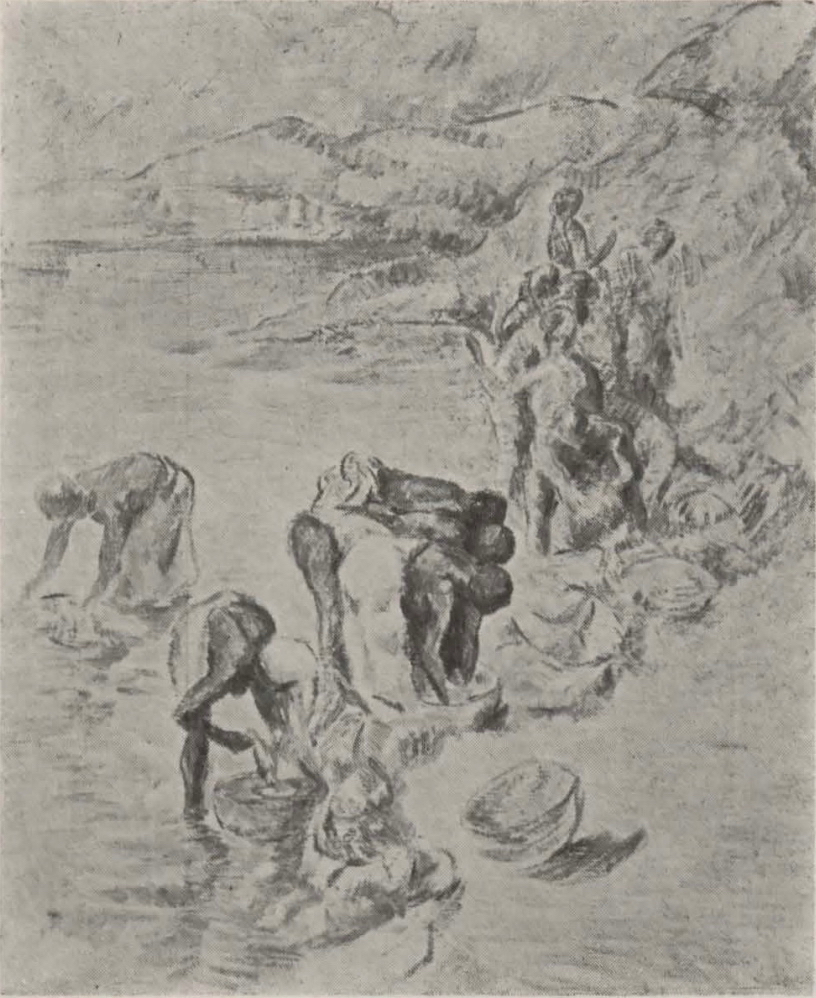
Washerwomen on the Niger River
ex Paintings of Africa brochure (Babcock Galleries, 1921)
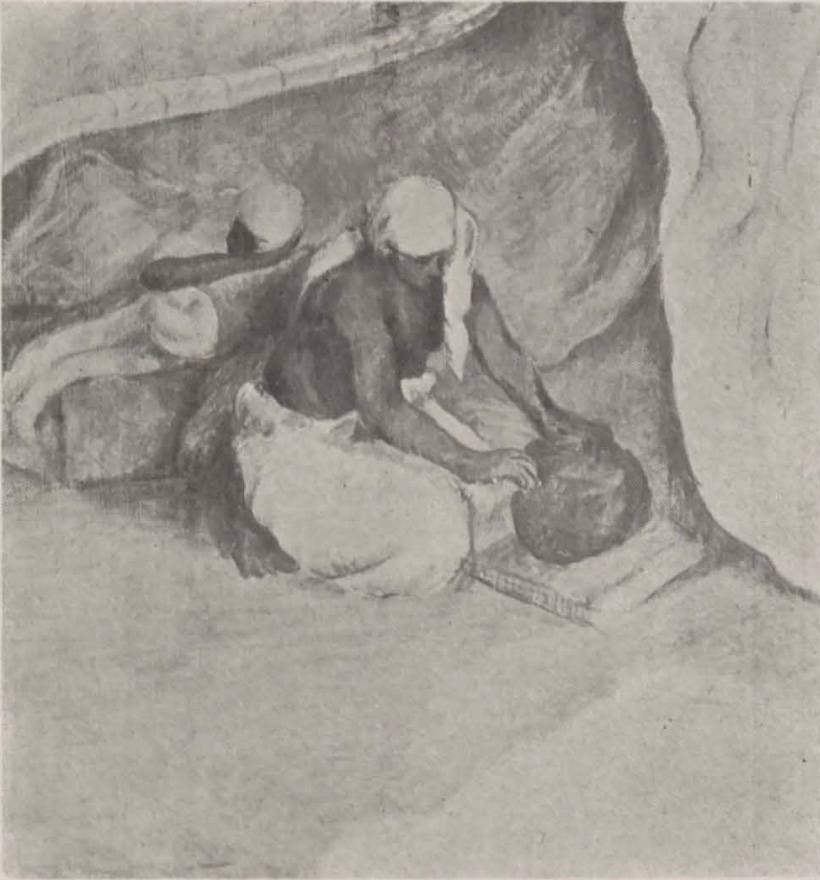
Girl Making Palm Oil
ex Paintings of Africa brochure (Babcock Galleries, 1921)
contemporary reviews of that exhibit
- The Arts (October 1921) : 52
via archive.org : linkMr. Leon Tahcheechee, whose African sketches are now on view at the Babcock Galleries, was not always an artist. Sadakichi Hartman reveals the fact that Mr. Tahcheechee has been a chef, a sailor and a seller of magic soaps; a restless man who has wandered over half Europe, Central America and most recently West Africa. He is an adventurer with the habit of making watercolors or pastels wherever he goes.
The paintings at the exhibition do not impress me nearly as much as Mr. Tahcheechee does himself. Such a man does not make his art a matter of life and death, probably because he has more than a rhetorical acquaintance with life and death. His art is sketchy, almost lost in a large canvas. And I feel that his painting is merely pastime. Compared to his conversation his sketches are decidedly flat. Nevertheless it is an interesting exhibit and Mr. Tahcheechee is a very interesting personality.- “Paintings from Africa by Leon Tahcheechee,” review by Henry McBride (following a piece on C. Bertram Hartman’s water colors of Maine and New York City) in The New York Herald (October 23, 1921) : Section 3, p3
via LoC’s Chronicling America : linkSadakichi Hartman, who, if I am not mistaken, was the original settler in Greenwich Village, disappears from view occasionally, but not for long and generally bobs up to do the kindly office of introducing some young unknown in whose talent he believes. This time he stands sponsor for Mr. Leon Tahcheechee, whose paintings form the first exhibition of the season in the Babcock Galleries.
Mr. Tahcheechee’s name has all the virtues that Mr. Bertram Hartman’s lacks. It Is startling enough at first glance to be unforgettable, and when pronounced is as musical as any Italian’s. Although young, he has already lived much, as Mr. Hartman’s note, which is worth quoting, shows:
[above essay by Hartmann repeated entire,
with “come to say” silently corrected to “come to stay”]
Mr. Tahcheechee already has a professional manner. He has breadth of view and decision, and will probably be more and more of a colorist as lie goes on. One of the best of his African studies is the head of the little Yoruba boy, which is touched with feeling; and one of the best of his etchings is the portrait of Mr. Sadaklchi Hartman, which shows a penetrating grasp of character.
more (snippets) on his life
- listed as “Village aboriginee” among village characters, in Bob Edward’s Guide to Greenwich Village (First edition, published by The Quill, 1919) : 14-17 (15) : via hathitrust : link
- Leon Tahcheechee (Tahch) Corwin, who has been visiting his parents, Mr. and Mrs. J. W. Corwin, left Thursday for New York City, his home.
item in “Local News,” The Claremore Progress (Claremore, Okla.) 17:30 (Thursday, July 14, 1921) : 3
link- Leon Tahcheechee, novelist, is really an American. He adopted the Indian name because he thought it more picturesque.
Mark Barron, “A New Yorker At Large,” Plattsburgh Daily Press (Friday, 7 August 1931) : 6
New York Historical Newspapers : link
- Your illustrious self no doubt has seen how Larches tremble in the wind? Your voice, illustrious Sultana, is one that falters, that has a catch in it that sends a sensation like a delicate electric shock up the spine, “a trifle hoarseness, a something of a break, which marks it as mere sound,” but gives it more power than that of sound. That voice therefore should be used to its fullest only for those who can whisper...
20260611