Horace Mummery. “Doubtful Tendencies”
(Paper read before the North Middlesex Photographic Society.)
The British Journal of Photography 46:2058 (October 13, 1899) : 646-648
via archive.org : link
aside —
a diatribe against the excesses — if not the very existence — of the “gum bichromate process” in photography.
transcription below; paragraphs numbered for ease of reference
—
Horace Mummery (1867-1961)
something about
other writings

- Photography, as most of you are aware, was originally discovered by the Chinese some five centuries before the Christian era, just previous to the discovery of the mariner’s compass, gunpowder, wireless telegraphy, and several other useful inventions, which, though lost at the fall of the Bang Foo dynasty, have fortunately been rediscovered in modern times. A hand camera found in an Egyptian tomb, and the interesting ruins of a dark room at Pompeii, show that the Western World was familiar with this art. The only reference to photography in any classic author that I am aware of is that beautiful passage in Juvenal, “Camera obscora lignea cot, bonus bona bonum.” This apparent lack of interest in the subject amongst the Latin poets is perhaps explained by the fact that, beyond a few photographers burnt by Nero for snap-shotting him, no encouragement was given by the State to this beautiful art. At the fall of the Roman empire the art of photography was lost, and there was no knowledge of it till its rediscovery at the beginning of this century, when a student of the Chinese language, deciphering the inscription on an ancient tea-chest, gave to the world the long-lost art; this happened at Margate, and the earliest experiments were conducted on the sands of that popular seaside resort, which have ever since been a rendezvous for photographers, the leading professionals usually making them their headquarters during the summer months.
- In the early days of the revival there was developed a certain amount of ill feeling between artists and photographers, owing, no doubt, to the extreme modesty of the latter; but, as this gradually wore off, the artist recognised in his rival a pleasant comrade, ever ready for an adjourned meeting or a willie waught. Willie waught, I may remark, is German for whisky, and it is this agreement in taste regarding special Scotch that has cemented the friendship between the two professions. Of late years all has been well between them, with the exception, perhaps, of a little irritation shown by a certain artist and critic who has been troubled in mind because of photographers signing their productions; but even this gentleman was satisfied when it was explained to him that the signatures were only there in case the pictures got lost, and were written large because they might happen to fall into the hands of short-sighted people.
- Despite a few such trifling differences, we have gone on in a friendly way, although the photographer, with his usual modesty, has laid claim to all the discoveries in modern art, and, out of sheer bashfulness, thinks that the artist is for ever copying from him. We have overlooked this, we have possessed our souls in patience. The artist may not be modest, but he is patient. That, too, is a virtue; but our patience has been sorely tried of late, owing to the discovery of a strange and mysterious process which has caused, sir, some of your craft to forget even their modesty. You have been kind enough to allow hitherto that the painter has still some slight claim to precedence, but now he holds it no longer, since the invention of this weird and wondrous process.
- You must forgive me going into technical matters, but I must briefly explain this process to you. Some paper is taken which is sensitised with blacking and gum mixed in unequal parts; after the usual exposure, or a little more or less, as the case may require, the picture is removed from the frame, then laid in hot water, and developed with a scrubbing brush. This is a very difficult operation, and it is said by some to work easier if accompanied by a little profanity. This, I believe though, is not absolutely necessary. The result is impossible to foretell, but of one thing you may make sure, the print will be nothing like the original negative. I may remark, for the guidance of the young bichromatist, that a print from a negative taken at noonday usually has the effect of midnight, but whether foggy, snowy, stormy, or fine, I cannot, of course, say, as this depends largely on the stiffness of the bristles in the developer, and, the strength of the language used. I have here two samples of the gum process. I will not criticise them. I must say, though, that I don’t think the best gum can have been used. I will pass them round to you, accompanied by two photographs from the same negatives; they serve to illustrate my remarks as to the change of weather and time of day. Since the discovery, or rather revival, of this process, many carbonaceous and unintelligible smudges have been brought into being, and have astonished and delighted those who produced them. I am speaking rather strongly about this process, rather too strongly, you may think, for one who has no practical knowledge of photography. I confess to having seen a few effective pictures produced by it — effective, though not really convincing, and, of course, I may be wrong in my strictures. It may possess capabilities of which I am ignorant, but, judging from results, it produces work that is, to my mind, vague and meaningless, [647] and without any excuse for being. Whether this is the fault of the process or the worker, it is not for me to decide. I have seen, since I wrote this paper, some gum pictures that closely resembled ordinary carbon prints, mere ordinary photographs, you know, but, of course, these do not come under my criticism, as I am dealing only with high art. Say what you will, a smudge is a smudge, whether it be a pleasant one or not, If you threw eggs against a black fence, you would soon have some erratic, and perhaps pleasing, decoration, but it would not be art. Now, this phase of photography, if we may call it photography, along with a deal of work of the same kidney, marks certain tendencies which I have taken the liberty of calling doubtful.
- Though photographers are ready to claim a large share in the advancement of modern art, they are apt sometimes to forget that the artistic application of photography has sprung from the study of painting; but, however this study is pursued, it should leave the photographer a photographer. I have chosen the gum-bichromate process more particularly for my abuse to-night, because I feel that in many of these productions the photographer has not felt the necessity of this, and, now that he is able to produce something that is eminently unlike a photograph, he is pleased to think that he has become an artist, and is ready to enter the lists with those who have bound themselves in a lifelong apprenticeship to art. I would point out here that the great and insurmountable difference between painting and photography is not, as is vulgarly supposed, that one is done by hand and in colours, and the other by a chemical process, but that one is the result of the light rays falling upon a sensitive plate, and the other of their falling on a sensitive brain.
- Art in its highest form is not a copy of nature, but nature tinged with human personality — in the great picture we have a new view of nature, a view from a fresh standpoint. That a good photographer will stamp his work with a certain amount of individuality I do not deny, but ask yourselves to what extent he may do it as compared with the painter? The painter, I think, has a right to speak strongly against these gum pictures and kindred work, because they are in many cases merely copies of his effects.
- Modern art, especially ae represented in the school known as the Romanticists, has shown us a subtle appreciation of nature that is called somewhat vaguely “quality;” this consists of a suggestion rather than an exact portrayal of nature, and is marked by looser and softer forms than in the more precise art of the past. This, of course, has made it easy for the copyist. The young painter has been long in the field ; he soon discovered that his water-colour rubbed with a sponge or sandpaper, or his oil-painting scraped down with a palette knife, had a dim resemblance to the quality got by the modern masters. We have all tried this sort of thing, just as a donkey runs down every blind-alley before he will condescend to trudge along the high road. We recover in time, however. Gum, by the bye, is not quite so sticky as it was a short time ago. The invention, or rather revival, of the gum-bichromate process gave an opportunity to those who were tired of following in the beaten track for trying something original, which, like most other original things nowadays, is just a crib from something else. We have been deluged with impressions in painting, but the wildest, strangest, weirdest impression of all is the carbonaceous one that, with name in corner written larger than ever, is brandished before us, whilst its maker proclaims from the house-top, “I am an artist!”
- There may be something pleasant about the mere look of the thing, something fascinating in the rich velvety darks and the wayward spots that are scattered around like the stars in the Milky Way, but personally I prefer photographs. I have seen on these walls, and in the London exhibitions, a great deal of interesting and sincere work that I frankly admit is art. It is photographic art, though, and is certainly not to be confused with painting or drawing, for these mean greater control over method and material than is possible to the photographic worker, and yet, curiously enough, the approximation to the artist’s work, which is claimed by some, has been reached by this process, whose principal element seems to be chance. If a photograph is to be modified or altered in any way, tbe process should be sufficiently under control to make tbe picture the result of the worker’s judgment and feeling. If it be not so, then there is no art displayed and no credit deserved.
- I do not think there can be much control in the gum process. If there is, then the pictures I have seen hitherto must be the result of downright deliberate wickedness, and are a strong proof of universal depravity. In other processes, too, there is the same tendency to impressionism. I maintain this is simply imitation of the painter.
- Impressionism in its true sense is tbe most difficult and dangerous part of a painter’s craft. It is the getting the very essence out of nature. A true impression looks full — fuller and richer than what is styled finish.
- We are told that Millet, the French peasant painter, kept digging away at his pictures when every one else thought they were finished, simplifying them. The most wonderful part of Turner’s work is the slight water-colours of the late period. Using the word impression to mean the simplest and broadest painting, it will, of course, include the noblest and greatest drawing, but the usual meaning of tbe word is the subservience of form to colour. To take, therefore, photography, the chief charm of which is its exact portrayal of form, and to smudge and destroy this form with nothing to put in its place, with no other object than copying those painters who are inimitable, is an utter waste of time and effort.
- I can sympathise with those photographers who are trying to destroy aggressive detail, to keep broad and simple masses. We often see this done successfully, and it can be done without going to the extreme of a wholesale sweeping together, which results in blurred edges and empty dark masses. You must remember in painting there is colour, and it is colour mainly that gives that indefinable quality that in the broadest work is often more satisfying than the greatest drudgery of academic finish. A true impression lacks nothing, except what it is better without. We cannot always say this of the photograph. Let me give a common enough example — a seascape with bright sky, dark sails, and hulls of boats and reflections. In many of these impressionistic photographs the sail, hull, and reflection are the same in tone and quality. Do not, in your efforts after dignity, ignore the slight, but necessary, differences between these things. To throw them all into one is absurd, and yet that is what is done by the gum process, and we are then asked to admire the rich darks.
- Coming back to the tendencies again, I may class this very doubtful one and some others under the head of copying painters’ effects without having found what they mean by them, and whether they can be rendered by photography at all. If the idea is to be unphotographic, success is often attained, for we are shown prints where everything that is most beautiful and interesting in photography is marked by absence. Let me give you an instance. Harking back to our much maligned process again, at times the blacking is left out, and some brown or red pigment takes its place, and the result is the suggestion of a bad chalk drawing that has been carried in the pocket for some weeks, and, what is so extraordinary, it resembles a bad drawing in the respect of want of form. Things become lumps, and you may often mistake a boat on the seashore for a cow in a clover field. This last statement you must not take quite literally. It is what the newspapers call un dit, which is French for a lie; but what I mean is that these things are really bad. Now, what does this mean? I should say that we have been looking at some modern drawing, and, seeing a wonderful effect got by apparently loose and careless touching, off we go for our gum and blacking, and the job’s done. But let us remember that behind every quick touch in the drawing was the master’s hand, disciplined by long labour, and touched by the gods with cunning beyond the rest of mortals. Nothing is more deceptive than the simplicity of consummate art, but its apparent easiness will mock the strength of our best hours.
- You will have already discovered that my tendency is towards wandering. You will excuse me, therefore, saying a few words here on texture.
- A highly polished surface is still a source of delight to the greater part of the public. Varnish is like charity, and covers a multitude of artistic sins. A smooth picture will win praise before one in which the brushmarks are shown. There is some reason in this. Roughness for roughness’ sake is false. Not many years ago brushmarks were a sort of trade mark on pictures. We used at school to revel in So-and-So’s brushwork — of course, in the best pictures you don’t think of rough or smooth, they just look right; the roughness in painting was a reaction from the old smooth dead pointing of the early Victorian period; and also because paint dabbed on and let alone has a finer quality than when it has been dragged about.
- Photography seems still suffering from such a reaction. First we had everything glossy and smooth, but now it is all pimples. The painter, if he uses a rough canvas, may kill the grain where he likes, or, if he works on a smooth one, may make texture just where he pleases; the photographer having to be content with one texture, the grain of his paper, which will show equally all over, it behoves him to choose that judiciously, according to the subject. It has surprised me to see sometimes very beautiful work quite spoilt by coarse granulated paper. This seems curious, but fact or fashion over-rides judgment. Canvas-grained paper or any other peculiar surface may be sometimes used with good effect, but great care is needed, or the result is unpleasing. I am afraid the real state of the case is that some successful work is done in some particular way, and there is a rush at once to copy it. Your modesty, no doubt, forbids you admitting this impeachment, but I confess it is so amongst painters.
- I wish to-night to treat all the bichromatists who may be present — I’m afraid that’s an error — oh, I see — treat them with Christian charity, because I must confess that I myself used to admire these peculiar productions. There is something pleasant about them at first tight, but imagine living with them. Fancy coming home at night, perhaps a little exhilarated, and catching sight of the fantastic shapes. Good heavens! have I got ’em again? but I will draw the veil. Perhaps, though, it is in the seeing double stage when these pictures appeal to the beholder, when to the sober man they appear only foolishness. This may be so. We will not experiment with it, however.
- The photographs that give the most lasting pleasure, and I see a good many that, hanging on our walls, would be a source of quiet delight every time we looked at them, are those where the worker, without any affectation or ambition to overstep the limits of his craft, has got hold of his process, and been content to get all the expression he could out of it. Technical excellence must be considered, the particular advantages of the process brought out, and the picture must look, even to the un- [648] initiated, as if it were the result of thought and care, and not of chance. I am afraid I am slanging things to-night, but any one outsider who takes an interest in photography must blame or praise this peculiar phase of it; it is not to be passed over in silence.
- If these things be experiments I would hold my peace, but, if experimental, they should be put into folios or the waste-paper basket, and not brought out as masterpieces.
- There is but one test for art, and that is sincerity. It must be begotten of sinoere admiration, and produced with sincerity of purpose. If art potsonon sincerity, we can respect even where we cannot admire. We must be watchful and ready to receive every new truth, but. on the other hand, we must be careful — and it is one of the great dangers of our modern life — we must be careful not to welcome as a bursting forth of light those things whose only claims to notice are novelty and peculiarity. Hardly a day passes now but we are treated by the press to the discovery of a great artist or poet, whose name will awaken, perhaps, for a moment an echo in the silence of eternity, and we flatter ourselves on the keenness of our perception, but, if a real prophet should be sent us, we should receive him as in the past with indifference or with scorn.
- Sincerity is the only test, for art is too wide to be compassed by rules or canons. The crowd that passes through the picture gallery looking for the prettiest will inevitably miss the best, but from honest men sincerity will ever receive respect, which usually ripens into admiration. The old art still stands because it is sincere, and some of the modern for the same reason will endure, though the names that are oftenest in the papers may be forgotten.
- Now what is sincerity in photography? The first thing, I should say, is that your work should be a photograph, a literal transcript of nature. Is nothing, then, to be modified or altered in the result that your camera gives you? Yes, to a certain extent. When you bring home your negative, I hope that you bring home, too, a vivid recollection of the scene, and some idea of what you are going to try for in your print; if not, it is no good trying to improve what you have got. Now, I maintain that anything is legitimate that will help you to produce the effect that you are aiming at. You may by knowledge and various methods of treatment get a more pleasing and truer picture than you would otherwise have obtained. I see no objection to hand work even, within reasonable limits — anything you like save fudging. I know it is vulgarly supposed that in painting some very fine effects have been got by fudging, but nothing worth doing was ever done that way. I have used the expression literal transcript in regard to your picture. I do not wish to narrow the bounds of photography, but I would point out that there are bounds, and very firm ones too, for you have brought in nature to help you, and she may bear a little guidance, but will not stand being driven. The light rays under your judgment and good taste produce your picture, you endeavour with limited means of modification to bring this piece of nature’s handiwork into agreement with your view and ideas of the scene. This may sound to you like a truism, but it needs enforcement to-day, when there are those about who wish to produce pictures on a photographic basis, and not really photographs. I mean by literal, therefore, that your picture is to be the effect under which the negative was taken, not merely an effect, however pleasing, for the simple reason that you do not start with a free hand. Stand out in the fields with a clean canvas and a fist full of brushes, and you may paint your dreams if you can, but, when you put your head under that black cloth stick to facts, because you must.
- I have been told seriously by some photographers that they use their camera as a painter uses his brush; well, they may think they do. Now the bichromatist not only believes this, but a deuced sight more, for he gives himself a licence that a conscientious painter would not think of taking, he messes about till he gets something, but whether he had any idea at starting of what that something was to be is another matter; it is not enough that a thing be brilliant or clever-looking — it must be true to be convincing. If you see something in nature, and try to get it and fail, no matter. You are nearer getting it to-morrow, but don’t trust to luck. A good painter would not begin a morning subject, and, if he mess it up, turn it into a night piece. He might by chance get something by doing so, for there is fluking in everything, but it does not want much knowledge to detect it from real play. There are many hazy ideas about today that would be better cleared away. One of the pathways to knowledge, according to Confucius, is to know not only what we do know, but also what we do not know. Now, in practical work, before we can make much progress, we have to find out what we can do and what we cannot do, and if gum and blacking should be the means of bringing home to any of us what we cannot do, they will have fulfilled their mission, and we shall be able to go back to photography sadder but wiser men.
- It is such a delightful task finding fault with yonr neighbour, especially when you can persuade yourself that you are doing it for his good, that I feel I must have one more slap, not only at the bichromatist but at all those who cultivate fuzziness. The judicious softening of certain parts is perfectly legitimate, but to make everything blurred and undefined just for the fun of the thing can only be part of that depravity that is still knocking about in Adam’s offspring. The wicked, who have always an excuse ready, will plead some of the great modern painters. Well, go and look at them, and see how much real drawing underlies their soft edges.
Horace Mummery
Horace A. Mummery (1867-1961)
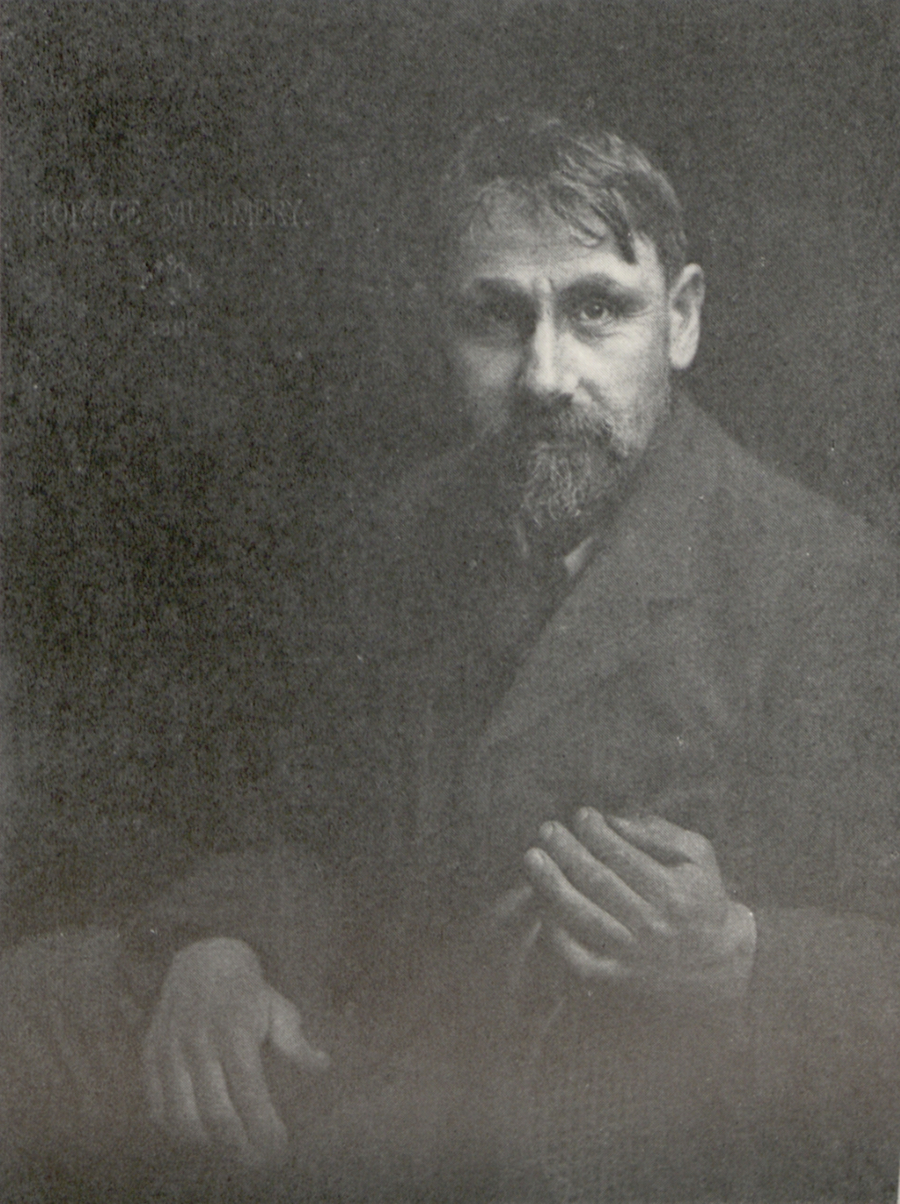
Portrait of Horace Mummery, Esq. by Furley Lewis Sulis Fine Art maintains a page devoted to Mummery : link [acccessed 20260707], “...painter of landscapes largely in watercolour, influenced by Turner and the French Impressionists. The last few years of his life were spent in Cheam, where he lived with his sister Una Constance Tilney and her husband, the Artist Frederick Colin Tilney. Tilney and Mummery were sketching companions who often found inspiration in the countryside around Midhurst in Sussex. Mummery, born at Iver in Buckinghamshire the son of a schoolmaster and Unitarian Minster. Mummery lived in Wood Green for many years and attended Hornsey Art School where he formed a close friendship with the artist Robert G. D. Alexander, a mutual acquaintance being the highly acclaimed watercolourist Hercules B. Brabazon. Horace Mummery came from an artistic family. His brother was the architect John Charles S. Mummery, who was also the President at the Royal Photographic Society...” other writings (as they turn up)
aside — 20260709
Illustration from 1909 Fifty-fourth Annual Exhibition of the Royal Photographic Society of Great Britain
1909 P09A121D
ex Exhibitions of the Royal Photographic Society 1870-1915
Catalogue records from the annual exhibitions
link
from which —
archive.org : link
ToC : link
archive.org : link
ToC : link
archive.org : link
ToC : link
U Minnesota copy/scan (via hathitrust) : link
ToC : link
U Minnesota copy/scan (via hathitrust) : link
ToC : link
U Minnesota copy/scan (via hathitrust) : link
ToC : link
U Minnesota copy/scan (via hathitrust) : link
ToC : link
taken from The Practical and Pictorial Photographer, London
via archive.org : link
ToC : link
have not been able to find source of this piece on “fuzziness” in The Practical and Pictorial Photographer up through 1906.