Florida Pier Scott-Maxwell (1883-1979) : writings, sorted / jmcvey.net
Florida Pier, later (and better) known as Florida Scott-Maxwell
stage actor, writer (short stories, essays, plays); Jungian psychotherapist; later wrote of aging, women in midlife, and, still later, her own experience of aging
The writings are sorted chronologically, within the sections outlined below. Transcriptions/reformattings are provided for some pieces, either because they are not otherwise available online, or as a means for the compiler to read, and even footnote or otherwise annotate them, carefully.
upper vertical bar ╹ at left returns to top of page

- short fiction
- The Gentler View
a series of some 165 essays that ran in Harper’s Weekly, 1908-1913 - The Woman Who Saw
short pieces in The [New York] Evening Sun ca 1909-?, widely syndicated; byline uncertain - sketches, essays
London sights; aging, women, psychotherapy; book reviews (to come) - plays
some produced, even published; most are earlier typewritten copies filed for copyright protection - plays acted in (1900-1905)
brief notes only - books
They knew how to die / The kinsmen know how to die (by Sophie Botcharsky and Florida Pier; 1931)
Towards Relationship (1939)
Women and Sometimes Men (1957)
The Measure of My Days (1968) - life (little progress here)
- ongoing asides
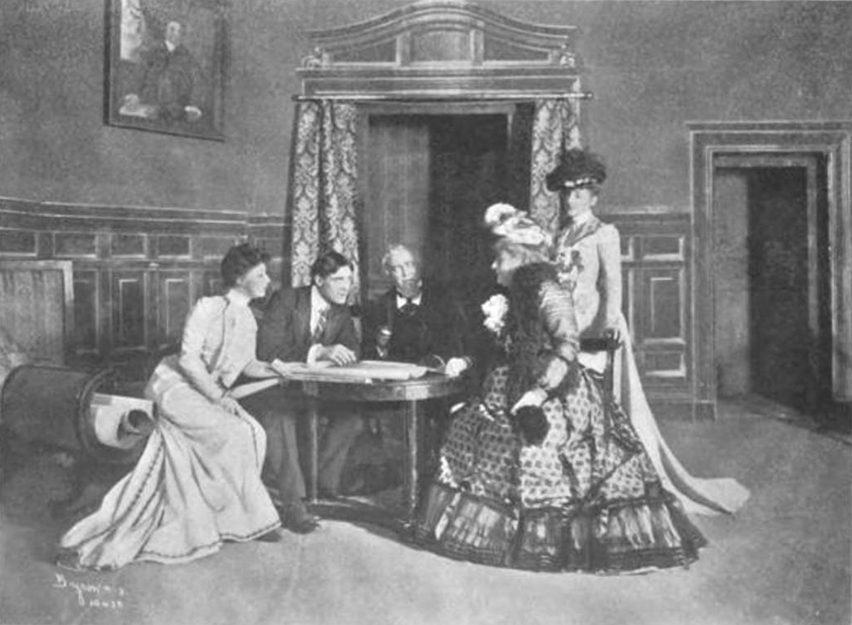
— The accompanying photograph of a scene from the second act of “Unleavened Bread,” now playing in Washington, shows Selma’s second husband, the architect, submitting the plans he has made for the Parsons house. Miss Tyree is Selma, Mr. E. J. Morgan is Wilbur Littleton, architect, Virginia Buchanan is Mrs. Parsons, Florida Pier is Miss Parsons, and George Woodward is Silas Parsons.
ex The Book Buyer 22:2 (New York, March 1901) : 98-99
google books : link
Harvard copy (better scan, also google books) : link
Florida Pier is at upper right.
Florida Pier
on the staff of the New York Evening Sun, where she conducts “The Woman Who Saw” column, and she also conducts “The Gentler View” column in Harper’s Weekly. Apart from these. Miss Pier has written many short stories, some of which have appeared in the Century, Harper’s, the Circle, and other magazines.
— The Writer 21:3 (Boston, March 1909) : 40 : link
short fiction
- Miss Harriet’s “Extravagance”
The Century Magazine 69:1 (November 1904) : 149-151
Ohio State U copy/scan (via hathitrust) : link
U Pittsburgh copy/scan (via archive.org) : link
transcription ; linkJames wrote Miss Harriet could n’t say just what; she had once started to read the only product of his pen that they had, a long column in a city newspaper, headed “Modern Tendencies...” The first line was recalled with fresh interest: “The happiness that is expressed by extravagance.”
- “The Power of Ancestors”
The Century Magazine 71:3 (January 1906) : 445-447
link (U Michigan copy, hathitrust) / same (Indiana U copy, hathitrust) - Your Mother’s Moors
Harper’s Magazine 118:705 (January 1909) : 404-412 : link
ToC : link
illustrations by May Wilson Preston (1873-1949) : wikipedia - “The Little Man with the Safety Pin”
Harper’s Weekly (May 1, 1909) : 22-23
link (hathitrust) / link (google books)illustrations by Howard V. Brown (1878-1945) : link / more (MagazineArt)
aside —
Odd tale, a kind of morality tale, where one — “I started the world with a vocabulary, and not much else” — who lacked conviction, even apparently was a thief who lost his job for it... now falls into a situation where he brings “the wrong girl” and an irresolute/regretful young man to an agreement.
Has a certain stage (I mean, theatrical, almost Twilight Zone) aspect to it; might be entirely done in a room and adjoining stairwell, although it does commence outside, on the street.
note to self : transcribe. - Napoleon’s Apples
Ainslee’s 23:6 (July 1909) : 129-136 : link
- Mid-Sea Madness
The Smart Set (A magazine of cleverness) 28:4 (August 1909) : 41-51 : link (Ohio State U)
ToC : link - Musty, Dusty Mr. Cullender
illustrated by Horace Taylor (1881-1934) : link (London Transport), more (Christie’s)
Munsey’s Magazine 42:3 (December 1909) : 389-398 : link
link (Hathitrust) - The Summoning Knocker
illustrations by William L(eroy). Jacobs (1869-1917) : LoC
Harper’s Magazine 120:720 (May 1910)
Princeton copy/scan (via google books) : linklike “The Last of His Family” set in Italy.
- The Last of His Family
Hampton’s Magazine 25:1 (July 1910) : 129-134
google books : link
hathitrust : link
ToC : link
aside 1
a kind of rewriting of the Jamesian trope, of wealthy young American woman, traveling in Italy, in the sights of the comtessa who needs the marriage to her son, to save the Raspaglione [quite a name! — grasping, rasping, rapacious...] family from vanishing. The family’s fortunes were, it is suggested, violently obtained, and maintained by tricks. The daughter, Spring Ripley, whose father made his money in buttons, “millions of buttons, miles of factories. We’ve climbed, though not so darned high, on buttons, and though I’ve never minded them particularly before, they make me quite crazy about the general bloodiness, as you say, of your family.” (131)
The comte (Paolo) is a playboy and under control of his mother. Spring notices that he cheats in tennis. Later, in an unwelcome and violent action, he kisses her — “her throat, her lips.” Spring has presence of mind enough to leave the palace. She avoids being trapped (or tripped by a fifth step, that has a meaningful role in the story).
Earlier, the comtessa asks about her name, Spring. —
The comte again acted as interpreter and the girl laughed. “That’s easy. My name is Spring. It’s rather foolish, isn’t it? We began to be able to afford poetry about the time I was born and mother rather let herself go on my name.”I wonder whether Florida Pier’s given name had a similar back story. See her subtle and beautiful essay on James, “The Pale Adventurers” in Harper’s Weekly (December 19, 1910) : 22 : link (transcription)
aside 2
in same issue,
Rheta Childe Dorr, “A Fighting Chance for the City Child” (July 1910) : 103-116 : link
in preceding issues,
“Making Over the Backward Child” (June 1910) : 809-822 : link
“The Prodigal Daughter” (“second article — what organized women can do to take domestic service out of the list of dangerous trades”) (May 1910) : 679-688 : link
“The Prodigal Daughter” (April 1910) : 526-538 : link
see also
“Women’s Battle for the Ballot” in The New Broadway Magazine 21:1 (July 1908) : link (Ann Lewis Women’s Suffrage Collection)Rheta Childe Dorr (1868-1948) : wikipedia : link
author of A Woman of Fifty (1924, 1925) : link - Mrs. Nolly’s Real Self
illustrations by James Montgomery Flagg
Harper’s Magazine 123:777 (October 1911) : 786-795
hathitrust : link - Rentin’ Hens
with Pictures by F. R. Gruger (1871-1953) : link (Society of Illustrators) / more (Saturday Evening Post)
The Century Magazine 83:2 (December 1911) : 214-219 : (link) (Harvard copy, via hathitrust)a father-daughter story.
- “Inheriting Bunchy”
Illustrations by Wallace Morgan
The Delineator 29:2 (February 1912) : 93-94 : link - Horse Management
[a short in the “Light on the Path” section], The FRA : A Journal of Affirmation, Exponent of The American Philosophy (July 1912) : xliii : link
ToC this issue : link
published by The Roycrofters, East Aurora, N. Y. : wikipedia : link
entire —
It is not that one is afraid of animals, it is just that we are at such a disadvantage in dealing with them, for we have no earthly means of telling what is going on in their heads. It is only our respect for horses that makes us — well, respectful in our treatment of him. It seems so unlikely that the day will not eventually come when horses will realize that they are much stronger than we are and rightly enough should dictate to us instead of permitting us to dictate to them. And what more likely than that the change should take place while one is on a horse’s back? No one can say the idea is unreasonable. When a horse is trotting smartly along, one is not afraid of what he is doing — that stands to reason; one is only absorbingly interested in what he may be thinking of doing. A change in plans on the part of anyone is upsetting if the plans concern you, but a horse, having no way of warning you, even if he was kindly intentioned enough to think it necessary, is apt to act so suddenly, and it is at such moments that actions speak with such jarring loudness. He may feel his actions to be beyond criticism, but as we lack all the deductions which led up to his sudden decision we can not help disagreeing with him and feeling a little chagrined that we were so much slower than he in coming to what he must feel to have been a simple conclusion. - Mr. Walker
illustrated by Arthur William Brown
The Delineator 72:5 (May 1913) : 356-357, 414
hathitrust : link - The Great Little Man
illustrations by Harvey Emrich
Harper’s Magazine 126:755 (May 1913) : 854-862
hathitrust : link[sudden event, here, hailstorm and broken window, precipitates major change. something like the story, the guy decides to stay longer in Europe (find it)]
- The Unemployed
illustrated by John Alonzo Williams (1869-1951)
Harper’s Magazine 127:758 (July 1913) : 281-291
hathitrust : link
father-daughter story - Florida Pier-Maxwell, “Darkness”
The New Adelphi vol. 3 (September 1929 / August 1930) : 18-22
hathitrust : link
transcription ; linkexcert —
...Sitting immobile, she stared at life. So one could be alive and yet be outside life, that noisy, warm place where other people were. She knew no door through which she might enter, and so she had strayed here where there was nothing but recurring night with days as too brief respites from the night.
Darkness threatened yet hid her from darkness. Light brought safety yet revealed her to darkness. Now she did not know of which she was most afraid, since one seemed but the opposite of the other.
aside —
C. G. Jung’s essay “Woman in Europe” appeared in The New Adelphi 11:1 (September 1928) : 19-35
There are themes in here that will be taken up by Floria Scott-Maxwell, about relationship, and indirect method, and the feminine in man, and masculine in women; I wonder too about her marriage to a logic-only electrical engineer John Maxwell Scott-Maxwell (1880-1951), referred to (I believe) in The Measure of My Days (1968) — "It is baffling to be loved by someone who is incapable of seeing you. It is pain to have your love claimed as a cloak that another may hide from himself.” - “Storm”
Pall Mall Magazine 5:5 (September 1929) : 76-89 ? link
[have not been able to locate, may not exist; only reference is from phisp.com : link]
not in volume 88 containing April-September, at NYPL : link; maybe in succeeding volume? (stored off-site) - “Miss Naseby’s Life.”
The Fortnightly Review 126 (October 1929) : 541-556
archive.org : link
also in Edward J. O’Brien, ed., The Best British Short Stories Of 1930; With An Irish And Colonial Supplement (1930) : 145-162
archive.org : linknuances of character (above all, of Miss Naseby’s brother, who comes over to Paris, from London, to see what is going on; she wants her investments to generate more.)
- Florida Pier, “Entering London”
The Adelphi 1:6 (March 1931) : 491-495
hathitrust : link
transcription : linka bleak story — moving on from divorce? starting anew?
- “Pray for the Princess”
Life and Letters 6:32 (January 1931) : 50-61has flavor of fairy-tale...
- “Bigger and Worse Lies.”
This Quarter 3:4 (April, May, June 1931) : 644-654
UC copy/scan (via hathitrust) : link
reprinted with different title — “Lies” — in Edward J. O’Brien, ed., The Best British Short Stories of 1931 (1931) : 173-182
borrowable at archive.org : linkthe narrator, a new arrival at the pension, gets to know two other residents there, Miss Cunningham who seems unable to tell a truth, and Mademoiselle Béraud and her “kaleidoscopic posturing” (647). The story is psychologically astute (like “Miss Naseby’s Life” of 1929), and brought to this mind Rachel Cusk’s Kudos trilogy for its use of the narrator, who draws the others out.
The Gentler View / Harper’s Weekly (1909-1913)
These are essays, not stories. Here and there are found thematic DNA shared with the short stories, and also with Florida Pier’s later writing — as Florida Scott-Maxwell — in particular her The Measure of My Days (1968).
The Gentler View series appeared in roughly three out of every four numbers, in what (beginning with “The Decency of Time” in the March 6, 1909 number) would be the “Advertising” section in the back of the issue.
Included here are four pieces from 1908, the first three of which preceded appearance of “The Gentler View” heading, but exhibit the same tone that is typical of essays in that series.
- “What Does Man Know of Woman?”
(November 14, 1908) : 33 : link
transcription : linkOne cannot be blamed for having a lively curiosity about the domestic happiness of certain of the learned gentlemen who have lately written on that burning subject, woman.
- “The Penalties of Authorship”
(December 5, 1908) : 29 : link
transcription : link- “The Passing of the New England Conscience”
(December 19, 1908) : 29 : link
transcription : link- “For the Suppression of Mothers”
(December 26, 1908) : 29 : link
transcription : linklast line — “What is Russian poetry to wet feet now?”
a wonderful piece, by — a mother.- “The Senseless Necessities”
(January 16, 1909) : 33 : link
transcription : linka suggestive catalogue — necessarily partial — of the micro-pleasures that pass without much notice, and of “bounce.”
- “The Serious Results of the Late Humor”
(January 23, 1909) : 31 : link
transcription : linkon the pendulum swing of fashion, humor’s rise (and current fall) — “our bodies mere banners with which to mark the pendulum’s half circle”
- “The Inadequate Eye”
(January 30, 1909) : 31 : link
transcription : link...and he has it on the best authority that if he does not see in the one and only way there is no use in his seeing at all. He would cut a much more respectable figure if he were blind.
aside —
a theme taken up elsewhere, perhaps in the story “The Great Little Man” (1913)?- “Confidences”
(February 20, 1909) : 31 : link
transcription : linkon indiscretion — on not keeping some things to oneself, and its irremediable consequences.
- “Collecting One’s Past”
(February 27, 1909) : 27 : link
transcription : linklike “Confidences” the previous week, somewhat philosophical. on the not-so pleasant actual past, softened with memory.
- “The Decency of Time”
(March 6, 1909) : 27 : link
transcription : linkon respect for time, giving it its proper due
- “The Disquietude of Being Liked”
(March 20, 1909) : 27 : link...Boys have been driven away to sea because their mothers so adored them. They have tried being wayward, but it is an exhausting business to perpetually remain the worst boy in the village when one’s inclinations draw one to a quieter life. Going to sea is their only chance of leading a harmless existence, and, at the same time, leaving the impression firmly behind in a mother’s mind that one is a good-for-nothing. To recall the really nice youngsters who have strained their powers of mischieveousness in an effort to down their mothers’ exalted idea of them is quite a saddening reflection...
The idea is elaborated in The Woman Who Saw series (below), “Why Chivalry Is Nipped in the Bud,” encounted in in The Kindergarten-Primary Magazine 28:8 (April 1916) : 234 : link
- Travellers, the Outer Shell, and a Man
(March 27, 1909) 29 : link
transcription : linkon the inevitable interpersonal dynamics problems of traveling in groups of three; on the mismatch of a person’s physical appearance with the realities of their personality; and on shopping for the wife’s coat, by a couple of a certain age (with the unhelpful aid of a saleswoman of a very different age).
- Guide-Books, etc.
(April 10, 1909) : 27 : link- Misfortunes, Mysteries, and the Happy Medium
(April 17, 1909) : 27
hathitrust : link
archive.org : link
transcription : linkon passing through cataclysms and misfortunes with no visible sign of having done so; on the infinite mysteries that are everywhere and when; and on the dangers inherent to taking the middle course
- Incorrigible Nature
(May 8, 1909) : 31
hathitrust : link
transcription : linkon the wanton actions (on poor humans) inflicted by Dame Nature, incorporating aspects of Sairey Gamp and Mrs. Grundy
- Tongues, Cameras, and Other Things
(May 15, 1909) : 27 : link
transcription : linkon speech untethered to mind — a logorrheic, stream-of-consciousness discourse on travel and foreign peoples; and on cameras, and the good fortune of having forgotten to bring one.
- Wandering Spinsters, Etc.
(May 29, 1909) : 29 : link
transcription : linkon spinsters — a particularly English expression and (by derivation) form of life — and their ability/propensity to travel; and on the curse that is the world’s multiple languages
aside —
so many spinsters in Florence and elsewhere; some living with their close/intimate friends and presumably lesbian — would Florida Pier have encompassed these in her short essay?- The Need of Self-Expression
(June 5, 1909) : 28 : link
transcription : linksecond thoughts about self-expression; what self might there be to express... virtues of opacity, non-disclosure.
- Panoramas, Etc.
(June 12, 1909) : 27
hathitrust : link
archive.org : link
transcription : linkon “views” — those scripted and exhausting perspective points that quite render the nearby (“The Blessed Ambient,” October 2, 1909) invisible; and the traveling signora, what happened upon the faint hope that the nearest church “might contain a chair and be otherwise lacking in points of interest.”
- The Tyranny of Buying
(June 19, 1909) : 27 : link- The Iniquity of Art Galleries
(July 3, 1909) : 27 : link- Subjects, Confidences and Decisions
(July 10, 1909) : 29 : link
transcription : linkon the subject as elusive quarry, and maze; on the provision of (irrelevant) personal story, in face of another’s immediate quandary; and on the impossibility of telegraphic clarity (“wire yes or no”)
- Concerning Plans, Etc.
(July 24, 1909) : 29
U Michigan copy/scan (via hathitrust) : link
archive.org : link
transcription : linkon plans — all must bow before plans, make way for them — and the weather, its refusal to be reticent, or unusual
- Proprieties, Absurdities, and Umbrella Carriers
(July 31, 1909) : 29
U Michigan copy/scan (via hathitrust) : link
archive.org : link
transcription : linkon the need to be economical with the facts, when what should have been a delightful time, turned out to be less so; and on the failure of absent-minded visitors to one’s house, to be done with talking of their own concerns, and attend to their host; and on the cognitive overload of negotiating pedestrian-crowded sidewalks with umbrella in hand (with a solution proposed)
- In Praise of Novel-Reading
(August 7, 1909) : 29 : link
transcription : linkon novel-reading; and on not finding a passage well-remembered from a prior reading, upon re-reading a book.
- The Venus of Milo and the Winding Road
(August 21, 1909) : 29 : link- Views on Slang, Lost Property, and Dentists
(August 28, 1909) : 29 : linkat p 13 ( link ), nice drawing of “A Book-worm’s Paradise” (the main reading room of the NYPL), by Vernon Howe Bailey
- Runaway Names, etc.
(September 4, 1909) : 29 : linkon lapses of memory; a fire in the house; and subjects to be avoided.
- The Disappointments of Surprise Visits; The Woes of Returned Travellers; etc.
(September 11, 1909) : 29 : link- This Matter of Being Comfortable, etc.
(September 18, 1909) : 29 : link
[the “once-upon-a-time” school in English art.- Sympathetic Antagonisms, Pets as Conversation-Silencers, Etc.
(September 25, 1909) : 27
U Michigan copy/scan (via hathitrust) : link
archive.org : link
transcription : linkon the stronger relationships founded on shared dislikes, rather than likes (or worse, vague middle grounds); and on the usages of pets (to fill in when the conversation flags); and on pretenses of success, and the concomitant casting shade on that of others
- The Blessed Ambient
(October 2, 1909) : 22
U Michigan copy/scan (via hathitrust) : link
same (via google books) : link
transcription : link- The Ostentatious Sea and Disappearing Man
(October 23, 1909) : 31 : link
archive.org : link
transcription : linkon the unpleasantness of sea-voyages, and (somewhat obscurely) on the absence of that cypher known as “man”
- Those Unescapable Exercises, etc.
(October 30, 1909) : 29 : link- The Educational Value of Hunger
(November 6, 1909) : 27
hathitrust : link
archive.org : link
transcription : linkon elective hunger, and the unasked for kind; and on realizing that one cannot trust — or that one doesn’t know — one’s own taste.
- Mothers Explained
(November 13, 1909) : 27 : link
also in Toronto Saturday Night 23:8 (December 4, 1909) : 31
archive.org : link
transcription : linkon daughters, and the changing role of mothers toward them; >followed by a brief paean to the sky — “the loveliest side of the world, no matter how lovely our side for the moment is...”
- Open Pictures, and Boomerang Ideals
November 20, 1909 : 27 : link
transcription : linkon falling into pictures (otherwise they are mere furniture); and — two Maurice’s — a critical take on Maurice Hewlett his Open Country : A Comedy with a Sting (1909); and a parody of Maurice Maeterlinck’s dialogic style.
- To Every Man His Own Plum, Etc.
(November 27, 1909) : 27 : link
transcription : linkon one’s personal blinders; and on what heaven may or ought to be like.
- The Delightfully Quaint Antis
(December 11, 1909) : 34 : link
transcription : linka point-by-point dismissal of the circular and threadbare reasoning of anti-suffrage men, told with acerbic and subtle wit
- Man’s New Humility
(December 18, 1909) : 27 : link
transcription : linkon descent of women from their pedestal, much regretted by men; and on the terrace of the Palazzo Rufolo, where Wagner wrote the Flower Music (or rather took down “what the place so openly dictated.”)
- Either One Does or One Does Not
(December 25, 1909: : 27
U Michigan copy/scan (via hathitrust) : link
archive.org : link
transcription : linkon seeing two or more sides to anything, to everything — “Suffering, deep thoughts, all concentrated at the end of their lives into a shattering, ‘One lives to learn, or rather one learns to live, or — well either one does or one does not.’”
- Typewritten Letters
(January 15, 1910) : 29 : link
archive.org : link
transcription : linkon typewriters (and their detrimental effect on letter writing); on snow (and weather, generally); on feeling accusatory (in the company of a modest person, who doesn’t fight back); and on time-zone differences and their influence over one’s imagining the more (or less) fast lives of distant relatives.
- Abjurers of the Hackneyed
(January 22, 1910) : 29
U Michigan copy/scan (via hathitrust) : link
archive.org : link
transcription : linkon a refusal to settle for what is not genuinely felt, or for hollow, empty expressions about what is felt; and on silence as sometimes best
- The Treachery of an Imagination
(January 29, 1910) : 27 : link
transcription : linkon the inconvenience (to self and to others) of having an imagination “of any thoroughness”
- The Solemn Responsibility of Influencing Father’s Vote
(February 5, 1910) : 27 : link- On Resembling Oneself
(February 12, 1910) : 27 : link
transcription : linkon resistance to personal change, our many tricks of doing so; and on stress on “minor moralities,” letting the larger ones alone
- Possessions
(February 19, 1910) : 27
U Michigan copy/scan (via hathitrust) : link
google books : link
archive.org : link
transcription : linkon people owned by their possessions, hoarders too
- Statistics and Genealogies
(February 26, 1910) : 29 : link- Generations, Pessimism, Dreams
(March 5, 1910) : 27 : link- Browning, and the Lost Cork
(March 12, 1910) : 27 : link
transcription : linkon Browning Societies, and reading-group-sized big questions; and on losing (and finding) a favorite cork stopper, somewhere under/behind the furniture
- Novelties — Waltzing — Broadway
(March 26, 1910) : 27 : link- Making Conversation, etc.
(April 2, 1910) : 27 : link- Profanity, Poses, and Tact
(April 9, 1910) : 29 : link“It does seem such a joke on the winter to be planting seeds in the back yard. The blustering cold thought it was going to do such damage, perhaps even succeed in discouraging us permanently; yet, though we led it on its hopes of making a tremendous fuss about the bad weather and pretended to be thoroughly depressed, we knew all the time that these days would come, and on the very first of them up every one popped armed with a trowel and a beaming smile and set to work ebulliently. It must be a great blow to winter. He must feel us to be so hopelessly irrepressible. He has worked for years to down us, and never have we failed to bob up chipperer than ever, always even enjoying a little the joke on him, recovering from our winter gloom suddenly, as though to make the mutiny more marked, throwing off winter’s influence with our tongues thrust impishly out. As we all do it at once, winter is, of course, powerless. He recognizes that we have escaped from his control, and in his rage he probably makes plans for an even severer winter next time. If we continue to make such open demonstrations of welcome to spring, winter will incrase his efforts and the Ice Age will result. We are tempting Providence by our open prancing interest in crocuses and upturned earth. It would be much more diplomatic to pretend that spring bored us, to dissimulate and cut our capes on the sly. In this way winter’s ire would not be roused and his accumulative revenge would cease to threaten us. Our present demented hanging out of the window because puttering has begun in the back yard is enough to provoke any one, especially a departing tyrant with a divergent theory. For our own good, if not for our own safety, we must stop our abandoned ecstasies.”
- Country Houses by James, etc.
(April 16, 1910) : 27 : linkwhere to go in the summer... “that modern development, the woman of affairs,” “self-reform”
- On Travelling Companions
(April 23, 1910) : 27 : link- The People We Write To
(April 30, 1910) : 29 : link
transcription : linkon writing and receiving letters; on the communistic (no private property, no privacy) quality of the post-card; and on virtue best practised privatedly (and vices best shared)
- Superhuman Maps, Etc.
(May 14, 1910) : 27 : link
transcription : linkon motoring with something like GPS (and what is missed thereby); on German tourists (“who dress[] from one view-point only”); and on napping through the tedious parts of a journey.
- Marriage and Steel Teeth, etc.
(May 21, 1910) : 27
hathitrust : link
transcription : linkon making a good choice in marriage, and — relatedly! — on the conscientious writer, trying to get his “facts” right.
- Italian Tea, etc.
(June 4, 1910) : 27
U Michigan copy/scan (via hathitrust) : link
archive.org : link
transcription : linkon the memories — and emotional transport — evoked by a cup of bad tea at the Metropolitan Museum of Art; and a rant on interrogatives, where a pleasant observation would better serve; with this postscript admission —
“On reading these complaints over the writer is amazed to find what a masculine flavor they have. She is quite unable to account for their discontented before-dinner tang.”- Bookworms, etc.
(June 11, 1910) : 27 : link“We cannot be too thankful for ignorance. The leeway it gives is tremendous. It is with real horror that one contemplates the approach of knowledge. It limits our flights, hedges us in, shackles and anchors us. The more we know of a thing, the more cowed we are in its presence; the less any one knows, the braver and freer our behavior. Halley’s comet has been a noticeable demonstration of this...”
- Careless Folk, Etc.
(June 18, 1910) : 27 : link- Rural Letters, Chapter Headings, Etc.
(June 25, 1910) : 27
U Michigan copy/scan (via hathitrust) : link
archive.org : link
transcription : linkon letters in the city, and how different from their rural counterparts, with paean to the the rural letter box, with its little red flag, out there doing its best in one’s interest; and on the lamentable disappearance of clever, suggestive chapter headings from present-day books
- Masculine Logic, Etc.
(July 2, 1910) : 33
U Michigan copy/scan (via hathitrust) : link
archive.org : link
transcription : linkon a man’s somewhat wayward, loosely scaffolded logic (versus a woman’s knowing her point, and arguing it efficiently, “perhaps indulging in a striking simile or two, but not going further afield”); and on the advantages (and charms) of rain in the countryside, versus its city counterpart
- Fellow Artists, Etc.
(July 30, 1910) : 21
U Michigan copy/scan (via hathitrust) : link
archive.org : link
transcription : linkon the misguided assumption that artists can endure company with their peers; and on a man’s dislike of a direct question, as if his manhood were threatened
aside —
see the rant, several weeks previous to this, re: the impertinence of questions (the second part of “Italian Tea,” June 4, 1910)- The Inconvenience of Ideas, Etc.
(August 13, 1910) : 21
U Michigan copy/scan (via hathitrust) : link
archive.org : link
transcription : linkon the riddling of actions with ideas, a recent advance — for ideas “do not get on well with one’s prejudices and comforts and instincts;” and on quiet, much more noticeable than noise, because of the noises that break into it
- The Depressing Effect of Humor
(August 20, 1910) : 23 : link- Castilian Shopping, etc.
(August 27, 1910) : 21 : link- The Great Emolument, Etc.
(September 10, 1910) : 21
U Michigan copy/scan (via hathitrust) : link
archive.org : link
transcription : linkon the staggering emolument of being a woman (versus a male with his pathetic external diversions); and on the nightmarish feeling that one is on the wrong train
- The Conservation of Revolutions
(September 17, 1910) : 21 : link- The Masculine and the Feminine Mind
(September 24, 1910) : 21 : link
transcription : linkIn fact and now the matter is to be settled once and for all — there is not a jot of difference between the masculine and feminine minds: there is only a difference in what is and what has been put in them, and what the world expects to come out of them. The world gets very much what it expects.
- Some Delusive Joys
(October 1, 1910) : 30 : link- The Agile Minority
(October 8, 1910) : 26 : link- Living Along
(October 22, 1910) : 25
U Michigan copy/scan (via hathitrust) : link
archive.org : link
transcription : linkon the dailyness of daily life, that “prevents our ‘doing’ to the praiseworthy extent we all intend;” and on being discovered to be reading a weighty book, “exactly as embarrassing as to be discovered reading a very yellow novel”
- Chance Encounters
(October 29, 1910) : 21 : link- People with Gardens
(November 5, 1910) : 33
U Michigan copy/scan (via hathitrust) : link
archive.org : link
transcription : linkon the narratives that the possessor of a garden insists on telling, or on expecting the visitor to be interested in; and on the officiousness of the (hired) gardener him/her self.
- Hotel Rooms
(November 12, 1910) : 26 : link- The Philosophy of Presents
(November 19, 1910) : 21 : link- Dinners and Men
(November 26, 1910) : 21 link- Blankness of Mind
(December 3, 1910) : 32 : link
transcription : linkIf we did begin to think — but at the very idea the cavalcade of our thoughts shows utter confusion. One limp little figure treading on the heels of the one in front, the smaller flâneurs getting bumped by those bigger thoughts who think they are marching, a serious congestion of traffic sets in...
- Pale Adventurers
(December 10, 1910) : 35 : link
transcription : linkon Henry James, his Strethers, so to speak.
- The Importance of Parents
(December 17, 1910) : 26 : link
better scan (Indiana U, google) : link- The Ploughers
(December 24, 1910) : 26 : linkthe keen mind, who ploughs the way for resentful others. —
“As we do not observe ourselves we cannot draw straight conclusions, and having no conclusions of our own, we borrow half thoughts from unaccounted-for sources, misapply them to things we learn of by hearsay, and with such a receipt for living, we breathe for seventy years or so, mere monuments of insensibility, with faith in our own infallibility and ignorant scorn for all else.”- Thinking in Detours
(December 31, 1910) : 26
hathitrust : link
Indiana U copy, better scan (lower left of page, via google books) : link
transcription : linkThough every man dislikes thinking and feels wronged when compelled to do so, no one can say that we have not reduced it to the terms least inconvenient to our comfort. We think in detours, add the spaces leaped by our thoughts are of far more interest than the thoughts themselves...
- Those Immoral Romanticists
(January 14, 1911) : 21 : link- An Opinion Embedded in Much Irrelevant Matter
(January 21, 1911) : 23
U Michigan copy/scan (via hathitrust) : link
transcription : linkon the quick,thrifty intelligence of women, versus the plodding and even stultifying sort of men; and a plea for a better and earlier preparation for women
- Being Dull Around the World
(January 28, 1911) : 31 : link- Emotions Attendant on Acquiring a Desk
(February 11, 1911) : 23
hathitrust : link
U Michigan copy/scan (via google books) : link
transcription : linkThere cannot exist a heart so dull that it has not thrilled to the word pigeonhole... ¶ ...and from then on you face life with the supported, sheltered, substantial feeling of one who is owned by a desk...
- Remembering, Etc.
(February 18, 1911) : 21
U Michigan copy/scan (via hathitrust) : link
archive.org : link
transcription : linka Proustian meditation on remembering — “Sounds melt and we keep but the emotion into which they resolved themselves. It is the same with books read and ideas discussed;” followed by a meditation on the sentience of herbs, prompted by an observation by W. D. Hudson in his A Shepherd’s Life
- Capitulating to Popularity
(February 25, 1911) : 35 : link- Evolution’s Culs-de-Sac
(March 11, 1911) : 21
hathitrust : link
archive.org : link
transcription : link- Consciousness
(March 18, 1911) : 21 : link
transcription : linkTo awaken late in life to the realization that one has bustled outwardly, while inside an immature blankness reigned, would be so awful that after a while to become conscious is out of the question. It would be too painful, to[o] rending a process...
- Summer
(March 25, 1911) : 23 : link- The Care of Genius
(April 1, 1911) : 25 : link- Two Difficulties that Confront the Seeker of Truth
(April 22, 1911) : 23 : linkon (1) the near-impossibility of admitting one was wrong, and (2) patriotism
- The Critical Sense
(April 29, 1911) : 21
U Michigan copy/scan (via hathitrust) : link
archive.org : link
transcription : linkon discrimination, and applying one’s critical faculties to humans, and above all, to those one most likes — “for always the voiced recognition of his idiosyncrasies remains a hillock beside the mountain of one’s royal regard”
- Flicked on the Raw
(May 6, 1911) : 33 : link
archive.org : link
transcription : linkon our unfounded — but founding — view of ourselves, our fastening on vices we have not, thereby concealing from ourselves those that we have
aside —
a recurring theme (leading to the author’s psychotherapeutic future), of our self-delusions and opacities- Domesticating Art
(May 13, 1911) : 23 : link
transcription : linkWe live with people either by an accident over which we have had no control, and cannot remedy, or because it is the only way to assure not se[e]ing too much of ourselves, and more than a little of them...; and on skipping in books
- Golden Spoons
(May 27, 1911) : 21 : link- Mementos
(June 3, 1911) : 25
U Michigan copy/scan (via hathitrust) : link
archive.org : link
transcription : linka piquant indictment of mementos (in all their forms, letters, photographs, etc.); with two subsequent (and titled) sections — The Sleepy Housekeeper’s Dilemma, on waking; and Rabbits and Periwinkles, on those cute maybe but damned rabbits
- Published Letters of Great Folk
(June 10, 1911) : 26 : link- Profiles
(June 17, 1911) : 26 : linkalso : Meetings, and Small Packages
- The Feeling for Games
(June 24, 1911) : 21 : link- The “My Room” Habit
(July 1, 1911) : 21 : link
transcription : linkIn almost every family there is one person who has what can only be called the “my room” habit. Its development may very probably be the result of family life; or the attraction of one’s room may be as strong as it is because one cannot say “my house.” Or, again, it may be a mere matter of temperament. This is undoubtedly the true solution. If one has the “my room” habit it is because one is made that way. To sociable-minded people who enjoy wasting time and find that it can be more unconsciously and comfortably done in company with others there is something enraging about those who softly remark, “I think I will be going to my room now...”
- Those Happy Hindoos
(July 8, 1911) : 21
U Michigan copy/scan (via hathitrust) : link
archive.org : link
transcription : linkon the vain wish to escape one’s mind and one’s body — “To be a cool, clarified, unthinking, and unfeeling wisp is our idea of ecstasy.”
- Short-story Marriages
(July 22, 1911) : 26 : link
transcription : linkon the romance vs the realities of marriage
- Bills
(July 29, 1911) : 34 : link- Lucid Days
(August 5, 1911) : 30 : link
same (U Mich copy/scan, via google) : link
transcription : linkon our evaluation of a day not rational, but mysterious, emotional; and, on emphasis
- Extracting Flavor
(August 12, 1911) : 26
hathitrust : link
google books : link
transcription : linkon the feminine passion for “tasting, for rolling scant, non-essential, or infinite experiences luxuriously on the tongue, for getting from all life’s processes the final grain of flavor,” that cumulatively yields intuitive strengths unknown to men
- A Characteristic or Two
(August 19, 1911) : 26
hathitrust : link
google books : link
transcription : linkon “words being the treacherous chameleon things they are;” and on perfection, and on blame
- Untimeliness
(August 26, 1911) : 21
hathitrust : link
google books : link
transcription : linkThe substitution of vagueness for processes fairly strengthens us in our opinions; also, on the oldest inhabitant, and authority
- The Provincial Mind
(September 16, 1911) : 24
U Michigan copy/scan (via hathitrust) : link
archive.org : link
transcription : linkon the closed mind, one that has “settled opinions on unsettled subjects” — which is not necessarily related to environment that can neither dispel nor engender it (and thus, like the open mind, might be found — or resuscitated — anywhere)
- Noise
(September 23, 1911) : 21
hathitrust : link
archive.org : link
transcription : linkon noise, and on the construction of admiration for others
- Great Happenings
Vol. 55, No. 2861 (October 21, 1911) : 34
hathitrust : link
transcription : linkon wanting the drama of important events or crises in our lives, and then minimizing them; and on the “common iniquity” of silently wishing ill of those who irritate us, and their refusal to mindread us.
- Handicapping Virtues, Etc.
Vol. 55, No. 2862 (October 28, 1911) : 26
hathitrust : link- The New Method
Vol. 55, No. 2863 (November 4, 1911) : 19
hathitrust : link
transcription : linkon bringing up children with an insistence on their personality, their uniqueness...; and the downstream problems of having done so
- Beauty and Boredom
Vol. 55, No. 2864 (November 11, 1911) : 26
hathitrust : link
transcription : link- The Archaeological Attitude
Vol. 55, No. 2866 (November 25, 1911) : 25
Purdue copy/scan (via hathitrust) : link
archive.org : link
transcription : linkon the virtues of archaeology, including its optimism, the fact that it involves digging, and that it is open to changing a theory once new discoveries come into view
- Happiness
Vol. 55, No. 2867 (December 2, 1911) : 26
Purdue copy/scan (via hathitrust) : link
archive.org : link
transcription : linkon the elusive quality of happiness, its resistance to analysis and to being shared, and a comparison with misery (that is said to love company)
- National Characteristics
Vol. 55, No. 2868 (December 9, 1911) : 26
hathitrust : link
archive.org : link- British Loyalty to Weather
Vol. 55, No. 2869 (December 16, 1911) : 32
archive.org : link
google books : link
transcription : link- From Door to Door
Vol. 55, No. 2871 (December 30, 1011) : 26
hathitrust : link
transcription : linkon canvassing for suffrage, door to door; a sobering, discouraging experience
- The Mental Pendulum
vol. 56 no. 2872 (January 6, 1912) : 30
hathitrust : link
same (University of Michigan) scan at google : link
transcription : linkThe dogmatism of philosophers either takes account of the strong pendulum instinct in each of us or else it does not. But then this is precisely the case with so many things....
- Hobbies
vol. 56 no. 2873 (January 13, 1912) : 26
Purdue copy/scan (hathitrust) : link- Public Speaking, Etc.
vol. 56 no. 2875 (January 27, 1912) : 31
Purdue copy/scan (hathitrust) : link- British Train Journeys
vol. 56 no. 2876 (February 3, 1912) : 26
Purdue copy/scan (hathitrust) : link- Historical Novels
vol. 56 no. 2877 (February 10, 1912) : 26
Purdue copy/scan (hathitrust) : link- Playing Up
vol. 56 no. 2878 (February 17, 1912) : 26x
Purdue copy/scan (hathitrust) : link- On Matches
vol. 56 no. 2779 (February 24, 1912) : 21
Purdue copy/scan (hathitrust) : link- Women and Their Furniture
vol. 56 no. 2880 (March 2, 1912) : 21
Purdue copy/scan (hathitrust) : link
transcription : link- Wearing Qualities
vol. 56 no. 2882 (March 16, 1912) : 26
Purdue copy/scan (hathitrust) : link
archive.org : link
transcription : linkon the qualities becoming to youth, gone to seed as one ages; and self-delusions relating to this process
- Centers of Congeniality
vol. 56 no. 2884 (March 30, 1912) : 23
Purdue copy/scan (hathitrust) : link- A Talkative Recluse
vol. 56 no. 2885 (April 6, 1912) : 24
Purdue copy/scan (hathitrust) : link
transcription : linkon the tortures visited upon others (and himself) by the accidental recluse, suddenly exposed to social situations.
- Random Reflections
vol. 56 no. 2886 (April 13, 1912) : 26
Purdue copy/scan (hathitrust) : link
archive.org : link
transcription : linkon servants (gardeners, nurses), whose perfect experience at the perfect “last place” reflects poorly on their current employer; and on “order,” its elusive nature, and our inability to see, let alone appreciate, another’s version of it
- What Is the World Coming To?
vol. 56 no. 2887 (April 20, 1912) : 26
Purdue copy/scan (hathitrust) : link- Authors of the Past
vol. 56 no. 2889 (May 4, 1912) : 18
Purdue copy/scan (hathitrust) : link- Current Events, Etc.
vol. 56 no. 2890 (May 11, 1912) : 23
Purdue copy/scan (hathitrust) : link- Markets
vol. 56 no. 2892 (May 25, 1912) : 21
Purdue copy/scan (hathitrust) : link- Tweeds, and other Things
vol. 56 no. 2893 (June 1, 1912) : 23
Purdue copy/scan (hathitrust) : linkon tweeds; on the danger of making moral remarks; and on weeding gardens (best done by women, who unlike men have the requisite determination)
- Babies, Etc.
vol. 56 no. 2896 (June 22, 1912) : 21
Purdue copy/scan (hathitrust) : link- Proverbs, Etc.
vol. 56 no. 2897 (June 29, 1912) : 23
Purdue copy/scan (hathitrust) : link- Routine
(July 6, 1912) : 26
U Michigan copy/scan (hathtrust) : link
Purdue copy/scan (hathitrust) : link- The Comic Again
(July 13, 1912) : 26
Purdue copy/scan (hathitrust) : link
archive.org : link
U Chicago copy/scan (archive.org) : link
transcription : linkon the charge that women would cease to marry, should economic independence and suffrage be permitted — a witty debunking, point by point
- Akin to Nature
(July 27, 1912) : 25
hathitrust : link- The Rueful Group
August 3, 1912): 26
hathitrust : link- “Nothing of the Kind”
(August 10, 1912) : 23
hathitrust : link- Devastating Happiness
(August 17, 1912) : 26
hathitrust : link- Random Railings
(August 24, 1912) : 23
hathitrust : link- Bits and Pieces
(August 31, 1912) : 26
hathitrust : link- Coming Home, Etc.
(September 7, 1912) : 22
archive.org : link
transcription : linkon housekeeping; “Some women never dare leave their homes for fear of the revelation that it could get on without them....; The life of a housekeeper is not a life at all. It is a maelstrom of petty charges...”
- The Romantic Mind, Etc.
(September 14, 1912) : 21
Purdue copy/scan (via hathitrust) : link
archive.org : link
transcription : linkon the romantic inclination toward [what I would call] enargeia, and to “chang[ing] life while it is in the act of being lived;” and (a strangely timely) reflection on the sense of property — a choleric attitude to protecting one’s own from tresspassing, that seems to have passed down from the gentleman owner to his servants [and latterly to an anti-immigrant everyman]
- The Younger Dramatists, Etc.
(September 21, 1912) : 21
hathitrust : link- Op. 29, Etc.
(October 5, 1912) : 24
hathitrust : link
transcription : linkon the wish that writers’ would number their works, as composers do, so that one might get a sense of the place of a given work in the author’s development and milieu; and on the resistance of the old to airy theorizings by the young — with a lovely excursus into gardening !
- Temperature and Other Things
(October 12, 1912) : 25
hathitrust : link- Gatherings
(October 19, 1912) : 25
hathitrust : link- Flowers
(November 2, 1912) : 21
hathitrust : link- British Cold, Etc.
(November 9, 1912) : 19
hathitrust : link- Perfunctory Christmas
(December 14, 1912) : 21
hathitrust : link- An American Trait
(January 11, 1913) : 40
U Michigan copy/scan (via hathitrust) : link
archive.org : link
transcription : linkon gobbling up, misunderstanding, and tossing aside for yet something newer, any new idea — this being the lamentable American trait
- Middle Age and Other Things
(January 18, 1913) : 21
hathitrust : link
archive.org : link
transcription : linkhidden behind its title, a melancholy meditation on the passing of friendships as one ages, and an anatomy of how that happens; followed by a short note on never finding someone in their office of a morning, where they properly belong
- Virtues and Vices
(February 1, 1913) : 26
U Michigan copy/scan (via hathitrust) : link
archive.org : link
transcription : linkon taking one’s vices to be virtues (with a note on Scotland’s pride in being called “churlish and taciturn”); and on the moral support provided by “Home, Sweet Home”
- “Awe of the Abstract”
(February 8, 1913) : 21
U Michigan (via google books) : link
same (via hathitrust) : link
transcription : linkon strong emotions, and avoidance thereof : “we only collide with it, and there is all the picking up afterward that naturally follows a collision”
wonder about terrible mismatch with her husband.- British Ornaments
(March 1, 1913) : 24
U Michigan copy/scan (via hathitrust) : link
archive.org : link
transcription : linkon the large and unsightly ornamental furnishings (“bright pink cheese dishes two feet high..., large dimpled mirrors trellised with painted pansies,“ etc.) found in the British house, and their disposal; and on the strange experience of public speaking
both of these pieces have the air of recent personal experience
- Premature Content
(March 8, 1913) : 29
hathitrust : link
transcription : link“content,” in the sense of satisfaction; on others’ contradictory attitudes about “a family that answers all the requirements of the model family of the future”
- An Idée Fixe, Etc.
(March 15, 1913) : 23
hathitrust : link
archive.org : link
transcription : linkcommences with an apologetic note on the inconvenience of having an idée fixe, followed by an elaboration of the author’s own, on women having been an unwitting subject of a socialist experiment all along : “...and they gave their services free. Nothing could be more socialistic. They were in return paid on the according-to-need system. With the rigorous and noble simplicity which the socialists advise, the women were given the necessities...”
- Our Appalling Consciousness
(March 22, 1913) : 25
U Michigan copy/scan (via hathitrust) : link
archive.org : link
transcription : linkon reform, and the fact that once achieved... “but how could we have forgotten? — there will still be us. We will each be as bad as ever. What a complete solace! Reform need no longer frighten any one.”
- The Crotchets of Equality
(March 29, 1913) : 23
hathitrust : link
transcription : link“one cannot expect the owner of a miniature gyroscope railway to share the modest thrills experienced by one who occupies himself with broken bits of shells picked up at random”
The Woman Who Saw
This column ran in the The [New York] Evening Sun ca 1909-16 ?; I have not located the column in that paper (online), but it was carried (syndicated?) in whole or part, in other publications of the time. What I have found is presented below; there may be more out there : link
Florida Pier is described as conducting the column in a short piece about her, in The Writer 21:3 (Boston, March 1909) : 40 : link. She is not named in the byline (at least in these other publications), and may not have authored all of the pieces under in the series. Still, her tone and subtle, wry humor are in evidence here and there. Others too were associated with the column, including Emma L. McAlarney.
One issue of the paper (February 12, 1909) is available at archive.org : linkThe Evening Sun, New York, N.Y., has begun a department “The Petty Philosopher,” for which brief contributions are invited. The Evening Sun also buys material for its department, “The Woman Who Saw.”
The Editor 38:9 (November 25, 1913) : link
and/but
The Evening Sun, New York, N.Y., has discontinued contributions for the “Teacup Philosophy” and “The Woman Who Saw” columns of its Woman’s Page. This is in accordance with an annoucement from Miss Eva E. Von Baur, Editor of the Woman’s Page>.
The Editor 38:11 (December 25, 1913) : 389 : linkmicroform at NYPL : link
The quality of that microform is not good.
- “The Right Word at the Right Time”
The Telephone Review 6:9 (September 1915) : 268 ; linkThe irregularities which come up all the time put spice into the jobs we are doing, especially in the matter of handling the public. “The Woman Who Saw” in the Evening Sun tells of a bit of diplomacy which we who deal with the public, whether from central or commercial offices, will not be slow to appreciate.
At the ticket window of a transportation company two people tried to buy tickets at the same time, having approached from opposite sides. The coins collided and one fell to the floor of the ticket seller's booth. Only one ticket was given out, and the girl who had parted with her money for no return waited for her ticket without result. Finally she stormed up the gateman, demanding the number of the man at the window.
It was a situation which needed to be saved. Puff! came the wind out of the sails of the excited girl as the gateman said slowly:
“G’wan through.”
“But what about the lost nickel?” She gased at him with a bewildering, beguiling smile.
“Well, if he don’t find it,” said the ticket taker consolingly, “I'll rob the baby’s bank. Go on through.”
. . . . .
Though an entirely similar situation would never be met in our experience, the essence of it is familiar — “The Public” — needing just the right treatment at the right time.
Many of you girls know of cases handled with as much diplomacy and success as this. Tell us about it!- “A Trolley Car Face”
The Western Fruit Jobber 2:6 (October 1915) : 40 : linkThis world-stage of ours, upon which all of us are merely players, occasionally furnishes some mightily amusing scenes of comedy and face — amusing, that is, provided we are so fortunate as to be standing in the wings and not actually engaged therein. An excellent example is the following tale of five fervid minutes in a New York City surface car, vouched for by a writer on The Evening Sun whose department is headed “The Woman Who Saw.” The car was well filled with the usual assortment of peaceable, undemonstrative types that seem to inhabit surface cars perpetually. Down two sides of the car they sat, staring dully into the eyes of their vi-a-vis in an open-eyed state of coma — save for the instinctive cringings with which they guarded their toes from the few who stood swaying in the aisle. A scene of bovine peace, upon which, without so much as a warning cue, enter terror, mirth, pandemonium, anguish, heroism, pity, love, loathing, and low comedy — all the usual attributes of melodramatic farce. The curtain rises :
A dignified Englishman and an attractively gowned woman boarded the car. He carried a much-labeled suit case and she carried a queer looking square tin box suspended from a leather handle. Just as they sat down on the long side seat, the car gave a jolt; the lid flew off the tin box, and out shot a streak of blurred gray and brown fur.
“Rats!” called out a cheerful man.
A dozen shrieks pierced the air and twenty-four black and tan pumps clambered up on the seats.
But it wasn’t a rat at all — it was a squirrel, and a mighty scared squirrel at that. He went tearing down the car, scurried up the new spring suit of the man in the corner, made the return trip over the hats of the astonished crowd and — disappeared.
The Englishmen [man?] looked bored. The woman with the deserted tin box began to cry. Then down on their knees the two went and under the seats they peered. The timid woman descended and joined them — likewise a few men. It looked like a Billy Sunday audience hitting the sawdust trail.
“He’s here!” “He isn’t!” “I’ve got him — no, I havn’t!” “There he is — I saw him.”
“Charlie,” rang out a woman's horrified voice, “come out of that dirty hole this minute.”
But Charlie, spick and span, aged six, crawled under the seat and was quickly lost to view. A moment later he emerged, triumphantly squeezing the squirrel — its heart beating like a trip-hammer.
“My baby— My baby!” cried the tin box woman as she snatched her pet and kissed it ecstatically.
The car had stopt at Forty-third St. A woman stood grasping the rail — her foot on the lower step.
“Is this the regular Madison Avenue car?” she asked anxiously.
“No,” said the conductor scornfully, “it’s the nut special — get right on.”- “Why Chivalry Is Nipped in the Bud”
in The Kindergarten-Primary Magazine 28:8 (April 1916) : 234 : linkHe was a little, eager eyed boy in a Scotch cap. The Woman Who Saw had noticed him the instant she boarded the car, because there was about him such a pronounced air of expectancy. When she took the last vacant seat beside him he gave a comically great sigh of relief.
“Mother,” he said, in a happy little voice, “the car’s all filled up now. If an old lady or a lady with a baby gets in I can give her my seat, can’t I?”
“Yes, dear,” said his mother. And then, catching the interested gaze of the Woman Who Saw, she smiled.
“I've been instructing my son in the duties of a male citizen to the community,” she said, parenthetically. “This is the first chance he’s had to put my teachings into practice, and we are so afraid that the ladies with babies will all stay home today.”
Indeed, that seemed to be the case. As the car went on the scarcity of eligibles for the little boy’s seat became more and more marked, and his anxiety increased apace. It seemed almost as if there were no ladies with babies left in the world. At last, however, the car stopped to take on a passenger; and instantly the would-be knight was on the alert.
“It might be a lady with a baby,” he said hopefully.
But it was not a lady with a baby. It was a ruddy cheeked, motherly lady, who immediately made the Woman Who Saw think of molasses cake and a sunny kitchen with a canary bird. The little boy watched her make her way toward a strap in the center of the car, his disappointment changing to deliberate calculation.
“Mother,” he said, “she hasn’t got a baby — but she’s a lady. Can I give her my seat?”
His mother said that he might and that he was not to forget to tip his hat. The Woman Who Saw could not help wondering how one would tip a sailor hat held on with elastic under the chin; but the little boy solved the problem very efficiently. Standing before the motherly lady, he raised both hands to his hat, and, lifting it an inch or two from his head, allowed it to snap back in place.
“Please,” he began, radiating importance. “Beg your pardon — there’s a seat up here.”
The motherly lady looked down upon him, smiling a great motherly smile.
“Well, well,” she said, in a hearty, mollasses-cake voice. “Is there!”
“Yes,” said the little boy, happily. “It’s my seat.”
With intense gratification he led the motherly lady down through the car, and watched her insert herself tightly between his mother and the Woman Who Saw. Then he stood and surveyed his work in satisfaction. Only a minute was he permitted to enjoy it; for the motherly lady, having arranged her goods and chattels to her liking, reached over and caught her youthful knight in her arms.
“Now,” she beamed, “just for being such a good little boy and giving me your seat you're going to have a seat too!” And oh, horror of horrors, — she lifted him upon her lap!
The instants that followed were fraught with a terrible intensity that made the Woman Who Saw think of the minutes preceding an electrical storm in summer. However, the boy stuck to his post of ignominy valiantly, although the Woman Who Saw, watching, could see that it required great effort. It was when the motherly lady, sublimely unsuspecting, had gone on her way and set him down in his own seat again that he turned upon his mother, and she quailed before the accusing light in his eyes.
“I gave her my seat!” he said, in a terrible undertone. “I gave her my seat and she made me sit on her lap, like a baby! I wanted to stand up like a man! I don’t care now if everybody in cars is old ladies or ladies with babies! I won’t get up and give anybody my seat! Never, never!”
The Woman Who Saw could not exactly blame him. Could you?
— The Woman Who Saw in N. Y. Evening Sun. - “Bigger and Worse Lies.”
- The Woman Who Saw
(Reprinted from the New York Evening Sun, October 24 [, 1916]), in Theosophical Outlook (“A weekly magazine devoted to the theosophical movement, the brotherhood of humanity, the study of occult science, and Aryan literature”) 1:46 (San Francisco, Saturday, November 11, 1916) : 367 : linkShe was a short, fat woman, with a round, fat face, and childish blue eyes. The Woman Who Saw met her waddling down the corridor of the public library, her arms piled high with books. In fact she was carrying so many books that when she took a hasty step forward, three huge volumes spilled out of her arms and thudded on the floor. She bent over to pick them up, when down dropped two more.
“Good Gracious!” she wailed, and the Woman Who Saw fled to her assistance. “I’ll wager $10 she’s getting literature on how to reduce her flesh; well, she needs it,” the Woman Who Saw thought, and with a smile she bent over to pick up the books. The titles that met her eyes almost made ger gasp; there was no “Eat and Grow thin” here, no indeed! Instead there was “Occultism.” There was “The Astral Body” and “The Secret Doctrine,” “Isis Unveiled,” “Karma," “Reincarnation,” “Planetary Influences.” “My Soul!” exclaimed the Woman Who Saw, “you don’t mean to read all of these, I hope?”
“I certainly do,” answered the fat woman emphatically. “I mean to read everything of the sort in the library. My husband says I’m crazy, but I’ll just tell you why I do it. I have five children, five noisy, troublesome children; my cook's given notice, and my nursemaid is no good. My husband’s been sick and is as cross as the dickens. Everything in the world in the line of trouble’s happened to me; everything always does happen to me; I’m fated.”
“So you're going to take your mind off your troubles?” smiled the Woman Who Saw, much amused.
“Indeed I am,” said the fat woman. “I find my outlet in reading. It gives me lots of pleasure. I can sit and read philosophies of the East by the hour, while the children fight, and not mind them at all. Do you know why I have so many troubles” — she fixed the Woman Who Saw with her mild blue eyes. “Because in my last incarnation I was a wicked person. My planetary influence is very bad indeed. I’ve got to work out a hard Karma; I’ve got to pay up for a lot of things. I know that. So when things go wrong I just say to myself, instead of crying: ‘This is my destiny; I have made my own fate and I shall overcome it.’ It works very well.” She gathered the books up in her arms again and faced the Woman Who Saw. “When I get through reading all these, I’ll be further than ever along the road,” she remarked cheerfully. “Maybe I'll be so far along that I’ll get to like my mother-in-law, and further than that my imagination won’t carry me,” and with a parting smile she went her was down the corridor. - “Honor to the Army”
The Railway Conductor 34:9 (September 1917): 685 : linkThirty-fourth street was crowded, hot and dirty. The Woman Who Saw hurried along to catch her train, conscious of weariness and depression. Suddenly at Sixth avenue a little band of ragamuffins scurried around her, six or eight little boys in various stages of undress, all a uniform grimy brown in color and each carrying a strip of lath — one with his in his hand, the others carrying theirs over their shoulders. On they swept with the utter unconcern of their surroundings which the child of the street acquires, darting from the curb and apparently doomed to destruction in the middle of the crowded avenue.
On the instant the big policeman saw them, around he swung, holding up two commanding, impassable hands, stopping the traffic so suddenly that the nearest taxi slid, stalling its engine, and the big truck horses on the other side came within an ace of sitting down, so suddenly were they pulled up by their outraged driver, who at once began to tell the policeman what he thought of him.
“Ah, wait a minute,” said the big policeman, still holding up his hands. “Can’t ye see these fellers go by? They’re soliders! Look at the sword this one has got!” He grinned at the leader of the urchins, who grinned back at him as he scampered along the sidewalk with the others. Away they ran, shouting. Then the big policeman waved his hand and let the waiting traffic through. — Evening Sun. - “A Jog to Memory”
New York City Mission Monthly 43:4 (June 1919) : 10 : linkRocco, aged seventeen, had enlisted over the protest of his mother. But his assignment of salary had been very useful to the family, as the Woman learned when she brought her green groceries. Then Rocco’s father fell ill, there was money owing, and for some reason the allotment failed to come. Heavily Rocco’s mother waddled across the street to consult the Woman, who could understand her limited English.
Letters and inquiries solved the mystery and she felt that she had done a good deed for the family. When next she saw Rocco’s mother the good soul beamed. “I gotta de mon. T’ree day ago. One hundred five-a dolla.” Then she pointed with pride to a pair of gold earrings with tiny diamond stones that hung from them under her black hair.
“How you like-a? I buy wit’ de mon.”
“What!” exclaimed the Woman. “You bought earrings! What of your debts and the sick husband? I thought you needed all of that money for necessities.”
“Sure, we need it. But,” and the mother of Rocco, with the army along the Rhine, smiled ingratiatingly, “I need-a it not to forget de war.” — The Woman Who Saw in the Evening Sun.
sketches, essays
- “London Sights”
Chelsea Embankment; Sunday in the Park; Tea Hour in a Big Shop
The New Statesman vol. 36, no. 920 (December 13, 1930) : 303
archive.org : link
transcription : link- “London Sights”
Cocoons in the Green Park; School Was Out; The Marble Arch
The New Statesman and Nation (incorporating The Athenaeum) vol. 1, no. 4, New Series (March 21, 1931) : 148-149
archive.org : link
transcription : link- “London Sights”
Rush Hour in the Underground; Court Ladies; Our Girls
The New Statesman and Nation (incorporating The Athenaeum) vol. II, no. 20, New Series (July 11, 1931) : 46-47
archive.org : link
transcription : link- “New Fiction.”
Time and Tide, xv (February 3, 1934), 148-149.
listed in E. R. Hagemann, “A Checklist of the Work of B. Traven and the Critical Estimates and Biographical Essays on Him; together with a Brief Biography”
Papers of the Bibliographical Society of American 53:1 (1959) : 37-67 (60)
archive.org : link“Unfavorable” review of B. Traven The Death Ship
have not seen- “Refractions”
Life and Letters vol. 9, no. 62 (February 1935) : 541-543
archive.org : link
transcription : linkan essay on the facets of a person’s life — Jungian perhaps? a poetic, philosophical dramatic monolog.
in five sections : statues (as if each a dancer, in a performance), spectrums, signals, actuality, predicament.
the relationship of the experience of living, to having/being in a body.- “So Near Mystery / A flight of questions on age,” by Florida Scott-Maxwell
The Listener vol. 51, no. 1307 (March 18, 1954) : 478-479
archive.org : link
transcription : link- “We Are the Sum of Our Days,” by Florida Scott-Maxwell
The Listener vol. 52, no. 1337 (October 14, 1954) : 627, 629
archive.org : link
evidently also in Harper’s Bazaar (October 1956)
transcription : linkfrom the next issue’s “Notes on Contributors,” The Listener (October 21, 1954) : 45
archive.org : linkMrs. Florida Scott-Maxwell is not, as stated last week, a psycho-analyst, but a psychotherapist.
- “Women and Sometimes Men”
(“The first of three talks by Florida Scott-Maxwell”)
The Listener (September 15, 1955) : 425-426
archive.org : link
transcription : linkon tapping the man within woman, and the attendant risks
- “The Feminine Paradox”
(“The second of three talks by Florida Scott-Maxwell”)
The Listener vol 54, issue 1386 (September 22, 1955) : 464-465, 479
archive.org : link
transcription : linksome splinters of the personal herein —
“It is heartening to have a man like her body, even though he may not have noticed that she is in it.”
and —
“Being self-forgetful is not at all the same as being selfless. Believe us, for we know, having been both.”- “A New Peace Between Man and Woman?”
(“The last of three talks by Florida Scott-Maxwell”)
The Listener (September 29, 1955) : 503-504
archive.org : link
transcription : linkon the need for better integration of the man (here seen as the “impersonal”) within woman, and woman within man
- Florida Scott-Maxwell, “The Greatness of the Task”
(from the book Women and Sometimes Men), in Ladies’ Home Journal (November 1958) : 61, 166
archive.org : link
Publication of her book Women and Sometimes Men (1957) occasioned increased visibility for Florida Scott-Maxwell and her ideas on women/men and feminine/male traits, in reviews, newspaper articles, and elsewhere. One instance was the forum that was featured in the same number of Ladies’ Home Journal, listed immediately above.
The title of that forum was “Should Mothers of Young Children Work? Unless a woman understands her role, she creates havoc among those she loves.” The magazine cover presented somewhat different (and differently nuanced) language : “Is money gain greater than children’s loss?”
Ladies’ Home Journal (November 1958) : 58-59, 134-136, 158-159, 161. archive.org : link
cover : archive.org : link
ToC : archive.org : linkThe participants (all White) in the Forum — and it is a quite interesting discussion, at the height of the Mad Men age — were:
Dr. Mirra Komarovsky
Dr. Lynn White, Jr.
Mrs. Florida Scott-Maxwell
James P. Mitchell
Dr. John Bowlby
Mrs. Roy Davis
Mrs. James Easton
Mrs. Charles R. Phillips
Dr. Doris Bartuska
Dr. William Franklin Graham
Milton C. Lightner
Frank J. Lausche, U.S. Senator from Ohio
Mrs. M. T. Cochran, Jr.
Mrs. Ernest Lee; and,
for the Journal, Bruce Gould, Beatrice Blackmar Gould, Margaret Hickey and John Younger.Other instances of this increased and wider visibility —
- Emotional Malnutrition
Battle of Sexes ‘Fault of Males’
The Daily Colonist Victoria, B.C. (April 1, 1958)
archive.org : link
transcription : linkarticle mentions that Florida Scott-Maxwell “turned to psychoanalysis in middle age because of the threatened breakup of her marriage.... She saved her marriage...”
This may have been important to editors and readers ca 1958; in fact, the marriage collapsed.- Book Review, Women and Sometimes Men
by Sheila (30-B-2) FPE
Transvestia 30 (1964) : 71
archive.org : linkThis book falls into a class with ASCENT OF WOMAN (Tvia #26) and FEMININE MYSTIQUE (to be reviewed) in that all of them are studies by very modern and intelligent women of themselves, women in general, and the masculine forces within them. Here credit is given to C.G. Jung, whose theoretical concepts are basic to all three. Mrs. Scott-Maxwell does not hesitate in telling the girls to recognize, utilize and ENJOY the man within them; one cannot help feeling that she would approve of our reciprocal efforts to accept the girl within us. Her Chapter V, “The Man in Our Nature”, could be made into an excellent imitation of a TVia editorial merely by reversing the She and He.
A few quotes are in order: “It is most uncomfortable to be a paradox", “We cannot fail to notice... the man sunk gracefully into his feminine side” (p18); “We must have the courage to say to (our masculine side): ‘You and I are two, not one, but I ask to know you for I see you’. (p56) “If man does not turn and form a whole with the feminine side of his own nature he is lost in very truth, cut off from his own enriching sources.” (p65) “Both boys and girls need great help in differentiating their secondary sex characteristics... it has been done to excess. All that was feminine was thought to be bad for the boy... and the distortion... began in earnest[”] (p108) Frankly, it is not ALL that good, there are dull (to me) chapters, and a little more clarity of language would be welcome in many places. However, with a little patience any TV will find this a gold-mine of understanding him/herself, and also of the wife who may be trying to help. The wives who are NOT trying if they can be induced to read it, may find themselves shaken right down to their hob-nailed soles!!!!!
Sheila, 30-B-2 - FPETransvestia was founded and edited by Virginia Prince (1912-2009), transgender woman and activist
wikipedia is excellent on Prince and on the magazine : link- Florida Scott Maxwell. “Early Memories of Jung.”
Inward Light vol. 36 no. 83 (Spring 1973) : 30-34
copy in handmentioned in Paul Bishop, “The Members of Jung’s Seminar on Zarathustra” in Spring 56 (“Journal of Archetype and Culture”); (Fall, 1994) 93-122 (116-117)
archive.org : link (accessed 20260725)
and in
Florent Serina. Florent Serina. A C. G. Jung Bibliography. A Selection of Books, Articles and Reviews (1970-2018) (2019)
10.32724/phanes.2019.Bibliography.Serina. hal-02500887
link (accessed 20260725)
plays
- When Julia Lied
copyrighted by Floria Pier between March 24 and April 7, 1904
source : The New York Dramatic Mirror (April 16, 1904) : link
aside — have not seen- Lovers in law; a fantastical romance in 3 acts, by F. Pier.
93 p. 4°. Typewritten.
© Florida Pier, New York ; D : 6074, Jan. 14, 1905 ; 2c. Jan. 14, 1905. 26671
from Dramatic Compositions Copyrighted in the United States, 1870 to 1916 (1918) archive.org : link- Dance of the Dolls
by F. Pier. 9p. 4º. Typewritten.
© Florida Pier, New York; D 7780, Dec. 29, 1905; 2c. Dec. 29, 1905. 9708.
LoC Copyright Office, Catalog of Title Entries of Books etc., Dramatic Compositions, 1870 to 1916 (1918)
archive.org : link- from Dramatic Compositions Copyrighted in the United States, 1870 to 1916 Vol. 2 (LoC Copyright Office, 1918)
archive.org : link2084
Secrets; play in 3 acts, by F. Pier.
[1], 73 p. 4°. Typewritten.
© Florida Pier, New York; D: 5604, Oct. 5, 1904; 2c. Oct. 5, 1904; 1c. new ed., title The secret, Oct. 23, 1907. 413702539
When a man tells; in 1 act, by F. Pier.
17 p. 4°. Typewritten. © Florida Pier, Easton, Md.; D: 6829, June 17, 1905; 2c. June 17, 1905. 501892542
When Julia lied; in 3 acts, by F. Pier
[95] p. 4º. Typewritten. © Florida Pier, New York; D: 4774, Mar. 16, 1904; 2. Mar. 16, 1904. 502452642
Younger (The) Miss Carkwell; in 3 acts, by F. Pier.
[75] p. 4°. Typewritten.
© Florida Pier, New York; D: 18040, May 23, 1908; 2c. May 238, 1908. 52217- Generations (The); a play in 3 acts, by Florida Pier [i.e., F. Scott-Maxwell]
[2]. 113p. 4º, Typewritten.
© 1c. Aug. 22, 1912; D:30938; Florida Scott-Maxwell, Glagow
archive.org : link- The flash-point, a play in three acts. By Mrs. Scott-Maxwell.
(London: Sidgwick & Jackson, Ltd., 1914)
U Michigan copy/scan (via hathitrust) : linkJean. Now mother, listen. Quite by myself, without any help from you, I’ve found and made my own intentions, plans, ideals. They are what thinking people believe in, and when I try to explain them to you you call me either impertinent or foolish. You potter about this house all morning doing things that could perfectly be eliminated, and in the afternoons you either do that useless embroidery or else you pay calls where people talk unkindly and stupidly.
p 30 : linkTaken up, somewhat critically (and with a useful summary) in “Play-Craft” by Robb Lawson, in The Bookman (July 1914) : 184 : link
reads better — as a story — than it might work on the stage.- Many Women
reviewed under heading “Nothing Too Much” in The New Statesman vol IV, issue 85 (October 8, 1932) : 406
archive.org : linkIt is a real achievement to avoid writing a tract in treating of the familiar struggle in the mind of a woman who wants to combine marriage with a career. Miss Florida Pier has no battle-cry about the mission of women in modern life. In Many Women, at the Arts Theatre, she is concerned rather to indicate, with the resigned gesture of the artist, that there is no case either for the feminist or for the woman at home. Everything, she points out, depends on the circumstances. Kate, the central figure of the play, has to give up her florist’s shop when she finds she is neglecting her home; on the other hand, Natasha, exotic creature of passion, realises that she has nothing to fall back upon when she is deserted by her lover. The hard and efficient young Nina ought never to have married at all, but poor deprived Lump needed a large family of children. The only connecting link between these diverse people is their common work in a grower’s nursery. The characters are excellently observed. Nina’s touching, inarticulate little husband, admirably played by Mr. Peter Ridgeway, is painfully true to life, and Nina and Lump, if presented with occasional exaggeration, are truthfully conceived. Even the stormy Natasha of Mis Olga Lindo is more than a piece of good theatre. But the author’s impartiality has its dangers. The very feeling for the variety and richness of life, which would have enabled her to make of this theme a good novel, has made her play undramatic.
dir. Esmé Percy; see Wendy Trewin, The Arts Theatre, London, 1927-1981 (1986) : 82
borrowable at archive.org : link- I Said to Myself
a play (Mercury Theatre), reviewed by John Sommerfield (along with two others, under the heading “A Real Waste”) in Our Times 7:1 (August 1947) : 13-14
archive.org : linkI Said to Myself is quite another cup of tea. The author had an idea for a new method of writing plays, the notion of using several actors to represent different aspects of each character; the heroine, for instance, is played by three people who are all on the stage at the same time.
As a new way of presenting human beings in the theatre the idea has possibilities. However, quite apart from whether the idea itself is good, bad or indifferent, and whether the way in which it is exploited is intelligent or the reverse, the playwright’s approach to it has been fundamentally wrong. It is quite obvious that the real motive of writing this play was the exploitation of an original approach and method. But for any new method or technique of writing (or music or painting or any other art form) to be valid, it must arise from the artist’s solution of the problems of the subject with which he or she is concerned. Here, the process has been reversed — a subject found for an original form instead of a new form devised for a subject that demands it.
Then the method itself has not been exploited either seriously or even consistently. It derives from the findings of psycho-analysis. Florida Scott-Maxwell is, I understand, a psychologist. An Adlerian psychologist, I should judge from this play. I cannot take her to task for basing her interpretation of human actions on a theory with which I do not agree and of which my knowledge is not sufficient to conduct a public argument. None the less, I would say that the way in which her characters are split is consistent neither with the facts of their conduct nor the formal demands of her play.
The heroine has three personalities; Lawrence, her husband, and Rose, his girl-friend, have two each; and Dick, the obnoxious brother-in-law, has only one actor on the stage to stick up for him. Dick is represented as a typical one-idea-ed person (we’ll discuss the idea later), yet his reaction to Rose’s other and libidinous self shows very clearly that he has another idea too, the same idea as Rose’s alter ego. I’m not saying it’s a bad idea, but why isn’t Dick represented by another actor to play this side of his character? The same question can be asked about the disparity between the heroine’s three characters and those of the others.
Finally, the story to which all this is fitted is entirely trivial and inconsistent itself. It hesitates between a feeble and uninteresting triangular situation—wife loves husband, thinks it’s all washed-up because of girl-friend, emotional scene, reconciliation and their relationship is more REAL than it was before — and a pretentious attempt at a satirical theme. Dick, admirably and solely played by Donald Houston, is the embodiment of all those mythological planners and evil bureaucrats that buzz in the bonnets of Tory newspaper leader writers. The part is written as oldfashioned farce. The writer’s own prejudices and confusions have resulted in that classical bloomer, to intend satire and produce low comedy.
It is not the play’s trivial plot and shallow characterisation that make it worth discussing. The important and interesting thing about it is that it does represent an attempt to get away from that West End convention of naturalism in the drawing room, which certainly isn’t naturalistic anyhow and whose drawing rooms never existed.
Incidentally, the play’s method presents considerable problems to the producer, which are hard to solve on any stage, and especially on a tiny one like that of the Mercury. In the circumstances they have been solved fairly well. And the actors do as well as can be expected with the material at their disposal. There are no brilliant performances, but no bad ones either. Sebastian Shaw is too intelligent an [14] actor to be able to take his part very seriously; no basis exists upon which he can be expected to show his real powers.
plays acted in
No attempt made at being complete; just want to account for these years — 1900-1905 — of Florida Pier’s life
Unleavened Bread
Comedy in four acts by Leo Ditrichstein and Robert Grant, dramatized from Grant’s novel of the same name. Produced at Savoy Theatre, New York (January 26, 1901)
Garrison P. Sherwood, The Best Plays of 1899-1909 (1944) : 386-387
archive.org : linkHearts Aflame
Play in four acts by Genevieve G. Haines, “suggested by Louise Winter’s novelette.” Eight performances (without Florida Pier) at the Garrick Theatre, New York, May 12, 1902; and with Florida Pier at the Bijou Theatre, New York, September 8, 1902
Garrison P. Sherwood, The Best Plays of 1899-1909 (1944) : 410
archive.org : linkDivorcons
Comedy in three acts by Victorien Sardou, translated by Harrison Grey Fiske. Revived by Harrison Grey Fiske at the Manhattan Theatre, New York, May 26, 1902
Garrison P. Sherwood, The Best Plays of 1899-1909 (1944) : 411
archive.org : linkGlad of It
Play in four acts by Clyde Fitch. Produced by Charles Frohman (1856-1915, wikipedia) at the Savoy Theatre, New York, December 28, 1903
Garrison P. Sherwood, The Best Plays of 1899-1909 (1944) : 449
archive.org : linkThe Coronet of the Duchess
Play in four acts by Clyde Fitch. Produced by Charles Frogman at the Garrick Theatre, New York, September 21, 1904
Garrison P. Sherwood, The Best Plays of 1899-1909 (1944) : 467
archive.org : linkBrother Jacques
supporting role in play headed by Annie Russell, at the New National (Washington, D.C.?, October 31, 1904)
The New York Dramatic Mirror (November 5, 1904) : 14
archive.org : linkThe Rich Mrs Repton
Play in three acts by R. C. Carton. Produced by Charles Frohman at the Criterion Theatre, New York, November 16, 1904
Theatre Magazine 4:46 (New York; December 1904) : 295
archive.org : link
Garrison P. Sherwood, The Best Plays of 1899-1909 (1944) : 473
archive.org : linkFriquet
by Piere Berton and “Gyp.” Produced January 31 at the Savoy Theatre
(Marie Doro plays the title role; Florida Pier plays Mme de Villiers)
Theatre Magazine 5:49 (New York; March 1905) : 56-57
archive.org : link
Garrison P. Sherwood, The Best Plays of 1899-1909 (1944) : 483
archive.org : link
“Friquet, an orphan, is found and brought up by Mafflu, a clown. She falls in love with the mayor of the town where she leaves the circus after the ringmaster has wanted to whip her into the ring. The mayor is, however, having an affair with Mme Schlemmer. When the two are discovered, Friquet protects Mme Schlemmer. She then returns to the circus, where she falls to her death from a trapeze.”
ex Hamilton Mason, French Theatre in New York (1940) : 135
borrowable at archive.org : linklist of cast, and review at The New York Dramatic Mirror (February 11, 1905) : 16
archive.org : link —
“Flossie Wilkinson and Florida Pier were pretty and ladylike, and continually alive to the picture, even though it was not worth while to be alive to.”
books
- They knew how to die
New York edition : The kinsmen know how to die : being a narrative of the personal experiences of a Red Cross Sister on the Russian front. Sophie Botcharsky and Florida Pier
(P. Davies / London and William Morrow / New York, 1931) : permalink (BL)
do not have dustjacket; cover illustration by Paul Wenck : link (Great War Dust Jackets, part of Alan Hewer’s fantastic resource : link)
Sophia Alfredovna Borman Botcharsky (1896-1982) : findagrave : linkSophie Botcharsky was the daughter of the Russian feminist, politician and writer Ariadna Tyrkova-Williams (1869-1962 *) and step-daughter of the linguist and journalist Harold Williams (1876-1928 *)
collection guide, The Tyrkova-Williams Collection at BL : linkreview by Arthur Ruhl (dramatic critic at the New York Herald Tribune), in The Saturday Review of Literature (October 19, 1931) : 184 : link (pdf; The Unz Review)
The book contains a preface by Bernard Pares (1867-1949), diplomat, historian, academic and writer (wikipedia). It concludes with this paragraph :
“Madame Botcharsky has had the advantage of collaborating with a writer, Florida Pier, who has helped her to put her experiences into a form which should carry conviction and interest to the reader, and the book should take an important place among the great records of that great and tragic story.”The book, btw, is cited/quoted in various studies of wartime nursing (and nurse anaesthetists), see for example :
Laurie Stoff. “The ‘myth of the war experience’ and Russian wartime nursing during World War I.” Aspasia, vol. 6, annual 2012, pp. 96+.
Gale Academic OneFile, link. Accessed 12 Jan. 2023.
It is Stoff who clarifies that Botcharsky’s surname is properly Bocharskaia.- Towards Relationship (1939)
- Women and Sometimes Men (1957)
- The Measure of My Days (1968)
borrowable at archive.org
- “London Sights”
life
still still still to come
—
Florida Scott-Maxwell is profiled in section 4, The Interior Life, in Colman McCarthy, Inner Companions (1976) : 221-224
borrowable at archive.org : link
other sections are 1, The Writing Life; 2, The Committed Life; and 3, The Spiritual Life.
from which —
Mrs. Scott-Maxwell — who was born in Florida and moved to Scotland when she married — is a lively and spirited letterwriter. In one recent note to me, she recalled her days in a clinic in Edinburgh. An incident she spoke of reveals her style of therapy: if one visit by a patient is enough for the patient, then let it be one visit—why drag it out for years of analysis? “A farmer’s wife came and told a tragic story where nothing could be done, but her compassion and strength made it possible to continue. As usual with these cases, I asked if she would care to come again; she looked a little surprised, and said, ‘There is no need, I’ve told you everything.’ She had only wanted to confide in someone she respected, in case there was more she could do, and not to be so alone in her hard life. . . . One visit was enough for her.” The best of the Jungian analysts stick to this method: a patient’s spirit doesn’t always need total rebuilding (at $25 or $50 a session), it may only need temporary relief. [223]
—
Then there is a question by Mrs. Scott-Maxwell, “At the end of your last lecture you spoke of the marriage in Christ, with the hands through the fish. Then I understood you to say man and woman cannot meet directly without trouble resulting. Will you please tell us why you feel this to be so?”
The chief reason is that, as an analyst, I am usually confronted with this most amazing fact, that when man and woman meet, some trouble results. It is generally true that the relationship between man and woman is not simple. But I quite understand that such a bold statement is irritating since we are all perfectly convinced that this should not be so; as you know, we chiefly think the things we like to think and dislike to think such irritating truths as trouble arising from love or friendship. Naturally we dislike such statements, yet if we look at the world objectively, we must ask ourselves why such an important religion as Christianity invented particular rites or particular ideas round marriage; and not only Christianity: we have plenty of evidence that [1094] this has happened in exactly the same way in other quarters at other times and in other civilizations. Every important phase of human life, or important decisions, are always surrounded by all sorts of magic because they are threatened by certain dangers; there are always risks connected with them. And anything so particularly important as the relationship between man and woman, perhaps the greatest intensity nature has ever invented, is so full of spiritual dangers, perils of the soul, that man always felt the need of particular magic, apotropaic means to make sure that the thing worked — since it is just as possible that it won’t work, or will work for a while and then turn into the opposite. So if you study the relation between man and woman with unbiased eyes — trying to refrain from thinking as you like, and forcing yourself to think according to what you really observe — you will see that there is usually a great deal of trouble.
That is the reason why I made this statement and it is also the quite obvious reason why Christianity tried to put something in between, some cotton wool or something of the sort, in order to mitigate the impact of those two forces, mutually attractive yet very opposite in character.
ex Lecture IV, 26 May 1937
Carl Jung, Collected Works Spring Term, May/June 1937
Nietzches’s Zarathustra / Notes of the Seminar Given in 1934-1939 by C. G. Jung. Edited by James L. Jarrett. Vol 1 (of two); Bollingen Series 99 (1988) : 1093
archive.org : link
ongoing asides
The project has had to take into account the various names by which Florida Pier is referred to, including F. Pier, Florida Scott-Maxwell, Florida Pier-Maxwell, Mrs. Scott-Maxwell, and Mrs. Scott Maxwell.
These different names might be her own choice, or someone else’s decision; they do, and do not, refer entirely to the same person.
20230106 — 20260907