Florida Pier Scott-Maxwell (1883-1979) : life, materials / jmcvey.net
Florida Pier, later (and better) known as Florida Scott-Maxwell
stage actor, writer (short stories, essays, plays); mother (three sons, one daughter); Jungian psychotherapist. later wrote of the situation of women and men in modern society (more schematically under the influence of Jung, anima/animus — the male principle in women, female principle in men), and of aging
On this page are gathered references and materials relating to Florida Pier’s life. It is an adjunct to the main page (linked above), that is a directory to her writing.
upper vertical bar ╹ at left returns to top of page

reminiscences (personal recollections)
family : parents, sibling, husband, children
circles : a friend of Alyse Gregory, Faith Oliver Powys, &c.
other mentions (including profiles)
research leads (archival materials, etc.)
reminiscences
- Florida Scott-Maxwell is profiled in section 4, The Interior Life, in Colman McCarthy, Inner Companions (1976) : 221-224
borrowable at archive.org : link
other sections are 1, The Writing Life; 2, The Committed Life; and 3, The Spiritual Life.from which —
Mrs. Scott-Maxwell — who was born in Florida and moved to Scotland when she married — is a lively and spirited letterwriter. In one recent note to me, she recalled her days in a clinic in Edinburgh. An incident she spoke of reveals her style of therapy: if one visit by a patient is enough for the patient, then let it be one visit — why drag it out for years of analysis? “A farmer’s wife came and told a tragic story where nothing could be done, but her compassion and strength made it possible to continue. As usual with these cases, I asked if she would care to come again; she looked a little surprised, and said, ‘There is no need, I’ve told you everything.’ She had only wanted to confide in someone she respected, in case there was more she could do, and not to be so alone in her hard life. . . . One visit was enough for her.” The best of the Jungian analysts stick to this method: a patient’s spirit doesn’t always need total rebuilding (at $25 or $50 a session), it may only need temporary relief. [223]
family
will include here what I can find on parents (and a grandfather, apparently important); one sibling; husband; children
- Anne Elizabeth Pier (White); (1861-?); mother
geni : linkMartha Grey Dyer (Pier); (1878-1966)
sister
geni : link- John Maxwell Scott-Maxwell (1880-1951)
his obituary, Institution of Electrical Engineers
Grace’s Guide To British Industrial History : link
from which :Mr. Scott-Maxwell remained with Electric Control, Ltd., until 1927, and shortly after retired from active participation in electrical engineering.
Throughout his life he had a strong conviction of what was right and strove for it and was often perhaps too outspoken for those who lacked his foresight and pioneering spirit. In the end his ever-fertile mind turned to more intellectual pursuits. During his last 20 years he devoted a great deal of time and study to the writing of a vast survey of modern knowledge. From this he sought to find evidence of a theistical and teleological purpose behind the creation of the universe, man and human consciousness, which to him was the only true basis on which evolution could be understood. He leaves this very ambitious work, which he sub-titled “Consciousness Alone Evolves,” unfinished and unpublished.married Florida Pier in 1910; divorced 1929 [1939 ?] and in same year married his secretary Isabella Wharrie (?-1972)
authored The Housing Scheme as A Social Training Centre (1935?)
full transcription via baillieston-streets.com : linkdescribed at Elizabeth Warren, Glasgow (2022) : 485-486
borrowable at archive.org : linkGarrowhill
The Garrowhill Garden Estate was founded as a co-operative venture in 1923 by J. M. Scott Mawell on orthodox, socially [486] enlightened garden-suburb principles. His pamphlet The housing scheme as a social training centre (1935) set out his ideals of social education, community involvement and creative leisure. The estate was to be provided with a church, primary school, institute and playing fields to form ‘that most essential feature of the scheme ... the community centre’.- Baillieston House
(I believe the house in which Florida Pier lived while married to John Maxwell Scott-Maxwell)
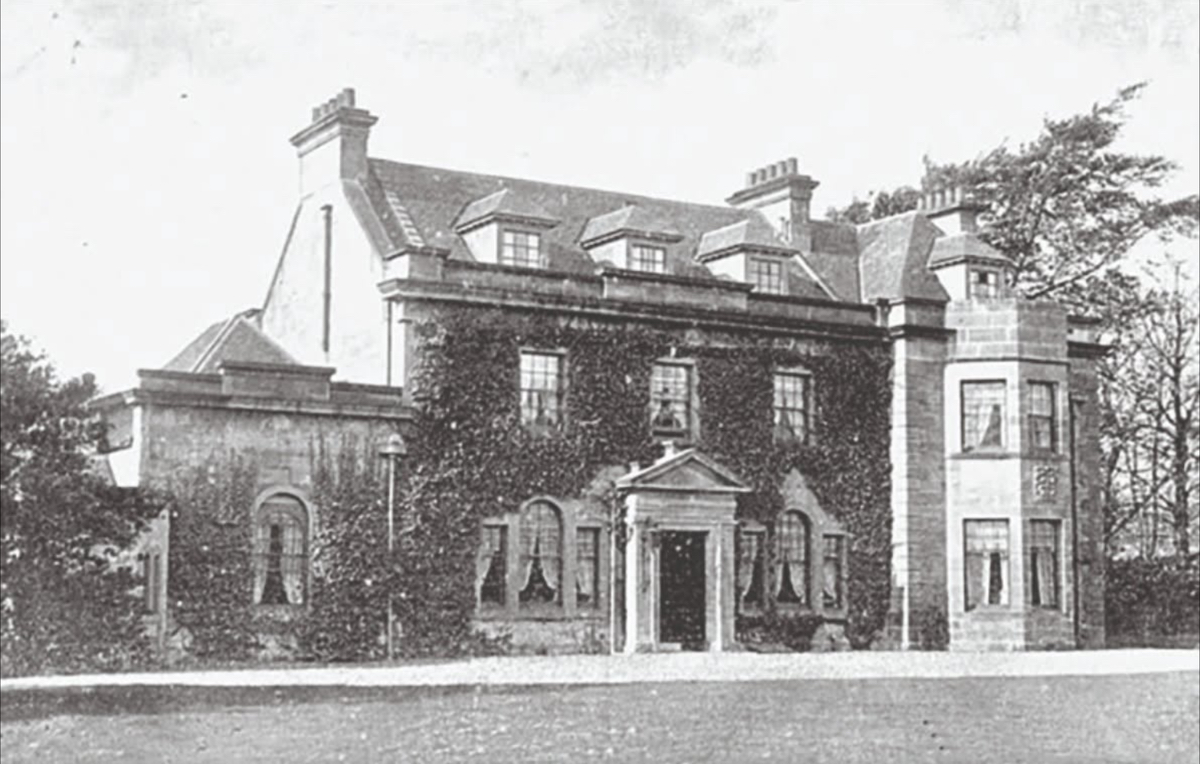
Baillieston House
Some background: in 1732, James Baillie acquired a plot of land at Barrachnie principally to gain the mineral rights below ground, the area becoming known as Baillieston. The land changed hands several times, with tobacco merchant James French developing the estate, and was later acquired by Major James Maxwell, who built Baillieston House in the early 1800s. His heir, John Maxwell Scott-Maxwell, altered and refurbished the house in the 1900s, and later, the trustees of the Maxwell family sold the estate to Lanark County Council in 1959. Baillieston House was burned to the ground by vandals in 1963 and later demolished.ex Memories of Old Garrowhill (and surrounding area)
posted by Graham McDonald (20260413) : facebook- four children
Ian Stephen*, (1911-89), engineer, company director
Hilary Henderson [?] (1914-2004), physiotherapist
Peter Douglas* (1916-90), Managing Director, Vickers Australia
Denis Gordon* (1918-?), textile industry, some patentsthis and some other Scott-Maxwell side information, ex :
Baillieston, The Name, The Estate, The Maxwells, The Family Tree : link
aside —
attempts to contact the maker of that invaluable work of love have failed, so far
Hilary
- A Broken Neck from a Protective Helmet,
an anecdote re: Hilary Henderson (nee Scott-Maxwell) —I was a physiotherapist at St Stephen’s in Fulham at the start of the war. It was bombed three times and each time a ward on each of the 3 floors would go. I was on duty at the time of the last bombing. The number of patients diminished as people were evacuated, so I left in 1940 and joined the WAAF. They didn’t need me as physiotherapist, so I worked in administration. I was very proud to have become a corporal.
I had to write to my father in Glasgow after every air raid because he worried so.
I got about London on my bike, which was a wonderful way to get around.
I had three brothers who were very worried about me being in London during the Blitz. My eldest brother sent me a helmet to protect me during raids. I was staying with friends and they insisted on me wearing the helmet when a siren went off. Later, on the bus, I was still wearing the helmet, but after the journey I found I couldn’t move my neck.
The doctors took an x-ray and discovered it had been broken by the heavy helmet and the movement of the bus. The doctors thought this a huge joke and teased me no end.
I had to be off work for 6 weeks, but couldn’t be idle. So I joined the Red Cross for those few weeks and spent the days labelling parcels.source : WW2 People’s War, contributed to BBC : link
- How I Met the Powys Brothers
Hilary Henderson’s mother was Florida Scott-Maxwell, dear friend of Alyse Gregory. Hilary was prompted to write this childhood recollection after returning to Beth Car for the first time in almost seventy years.
My mother, younger brothers and I were staying at East Chaldon with Mrs Way. Each day we went to the White Nose to see Llewelyn and Alyse. We used to go for long walks and when the weather was bad and the mist came down, they would worry in case we fell off the cliffs, so we used to play charades, or Llewelyn would tell us stories. We also walked in East Chaldon and I was shown a house called Beth Car, but told not to go near it as the man who lived there was not to be disturbed. I was not told who he was, or why I should not disturb him.
Bertie arrived, we were walking through Chaldon and he made for the gate of Beth Car. I hung back and said, ‘I have been told I must not go there’. Bertie picked m e up in his arms, opened the gate and the front door, and put me on the lap of another brother, Theodore; he kissed me and said, ‘At last I have you!’ There was not another day that I did not see him. I was eight years old.
Hilary Hendersonsource : Powys Society Newsletter 32: (November 1997) : 34
link (pdf)
circles
friend of Alyse Gregory (1882-1967) and Faith Oliver Powys (1897-1983), associated with Withymead
- Susan Hogan, Healing Arts : The History of Art Therapy (2001)
Chapter 9, “Britain’s First Therapeutic Community Dedicated to Art Therapy”
archive.org : link (removed, but usefully searchable)other
- ex Lecture IV, 26 May 1937
Carl Jung, Collected Works Spring Term, May/June 1937
Nietzches’s Zarathustra / Notes of the Seminar Given in 1934-1939 by C. G. Jung. Edited by James L. Jarrett. Vol 1 (of two); Bollingen Series 99 (1988) : 1093
archive.org : linkThen there is a question by Mrs. Scott-Maxwell, “At the end of your last lecture you spoke of the marriage in Christ, with the hands through the fish. Then I understood you to say man and woman cannot meet directly without trouble resulting. Will you please tell us why you feel this to be so?”
The chief reason is that, as an analyst, I am usually confronted with this most amazing fact, that when man and woman meet, some trouble results. It is generally true that the relationship between man and woman is not simple. But I quite understand that such a bold statement is irritating since we are all perfectly convinced that this should not be so; as you know, we chiefly think the things we like to think and dislike to think such irritating truths as trouble arising from love or friendship. Naturally we dislike such statements, yet if we look at the world objectively, we must ask ourselves why such an important religion as Christianity invented particular rites or particular ideas round marriage; and not only Christianity: we have plenty of evidence that [1094] this has happened in exactly the same way in other quarters at other times and in other civilizations. Every important phase of human life, or important decisions, are always surrounded by all sorts of magic because they are threatened by certain dangers; there are always risks connected with them. And anything so particularly important as the relationship between man and woman, perhaps the greatest intensity nature has ever invented, is so full of spiritual dangers, perils of the soul, that man always felt the need of particular magic, apotropaic means to make sure that the thing worked — since it is just as possible that it won’t work, or will work for a while and then turn into the opposite. So if you study the relation between man and woman with unbiased eyes — trying to refrain from thinking as you like, and forcing yourself to think according to what you really observe — you will see that there is usually a great deal of trouble.
That is the reason why I made this statement and it is also the quite obvious reason why Christianity tried to put something in between, some cotton wool or something of the sort, in order to mitigate the impact of those two forces, mutually attractive yet very opposite in character.
research leads
- Yale Divinity Library
Scott-Maxwell, Florida
Unitarian Universalist Women’s Heritage Society Records (RG 301); Box: 3
Call Number: RG 301, Series I
link (20261023)- Alyse Gregory papers (YCAL MSS 163) Beinecke Rare Book and Manuscript Library
link (20261023)from the Finding Aid :
Series I, Correspondence , (boxes 1-54) : “Also present is earlier correspondence concerning her social reform and literary career in New York, including transcripts of Gregory’s letters to Florida Scott-Maxwell, concerning social reform and suffrage work”
b. 36, f. 622-631 Scott-Maxwell, Florida 1936-66, n.d.
b. 36, f. 632-636 Scott-Maxwell, Florida (transcripts) 1910–58 Jan
b. 37, f. 637-645 Scott-Maxwell, Florida (transcripts) 1958-65, n.d.
b. 72, f. 1268 Scott-Maxwell, Florida n.d
also, Scott-Maxwell, Hilary :
b. 70, f. 1205 Henderson, Hilary (transcripts) 1929, 1932“During this period [1914-16] she [Alyse Gregory] was drawn into a social circle centering on social work, suffrage, and pacifism. Gregory discusses many of her relationships with these friends and lovers in her autobiography The Day is Gone, sometimes employing pseudonyms. Friendships established during this period include those with literary critic Randolph Bourne and social reformers Maurice Robertson ("Maurice Stevens"), Agnes de Lima, and Florida Scott-Maxwell.”
from Finding Aid, pp 5-6Alyse Gregory (1882-1967), suffragist, writer, editor The Dial
wikipedia : link- Evelyn Hardy papers (YCAL MSS 404); Box 1
Beinecke Rare Book and Manuscript Library
Scott-Maxwell, Florida, 1968-1972, undated
link (20261023)
- Anne Morrow Lindbergh papers (MS 829)
Yale, Manuscripts and Archives
link (20261023)
b. 20, f. 402 Scott-Maxwell, Florida 1955-1969
from Finding Aid, p22- Letters : to Henriette Metcalf, 1967-77
Beinecke Rare Book and Manuscript Library
Yale Collection of American Literature manuscript miscellany
(YCAL MSS MISC) Box: 9, Folder: GROUP 170, F-1
link (20261023)
“Twenty-seven ALS and two TLS, with two envelopes, 1967-1975, and 3 TLS, photocopies, 1976-1977.
Letters concern Alyse Gregory, Gregory’s death and a projected publication of her letters by Rosemary Manning, and Scott-Maxwell’s writing and news of her family.
Also present are two TLS and a card, holograph, signed, with two envelopes, from Scott-Maxwell to Addison M. Metcalf, 1968 and 1974; a TLS and TL from Rosemary Manning to Metcalf, 1968; and an ALS from Alan Parkes to Metcalf, 1968.”
- Anne Elizabeth Pier (White); (1861-?); mother
20261026